Traffic and Safety Update

By Julie Lees and Jean Kaplan Teichroew

The Traffic Committee has been working with Oscar Yen, a traffic operations engineer at the Montgomery County Department of Transportation (MCDOT), to review traffic-control and pedestrian-safety measures in North Woodside. Following is an update on the issues we’ve discussed and their status:

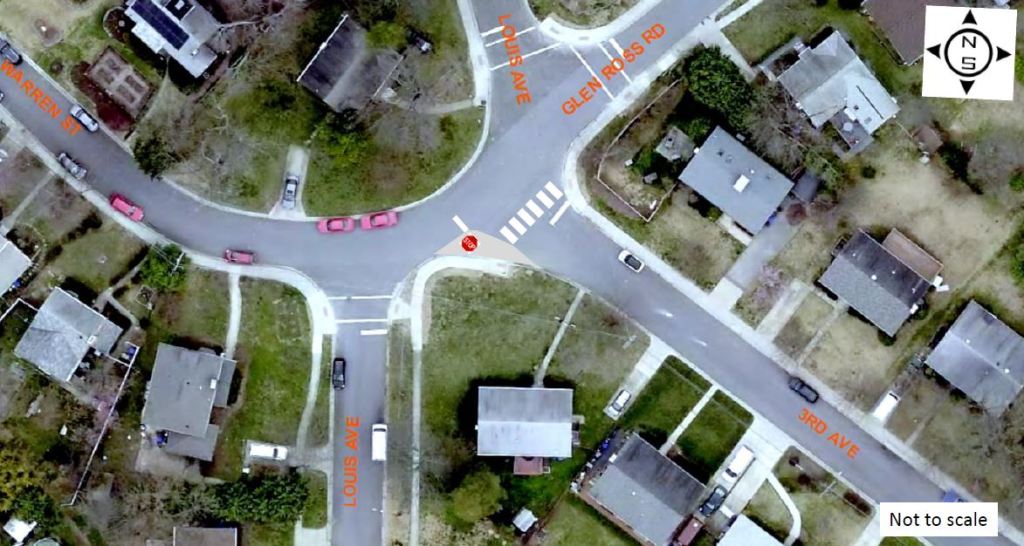
  1. Glen Ross, 3rd, Warren, and Lanier: To improve visibility in the intersection, MCDOT is working on the bump out at the corner of Glen Ross and 3rd. Neighbors in adjacent homes have been contacted, and the plan has been approved.

  2. Columbia:
    a. To fix the stop sign at the exit of the public parking lot, MCDOT sent an email to Montgomery County Parking Department, which maintains the parking lot.
    b. A new stop sign was installed at Rookwood.

  3. Intersection of Luzerne and Columbia: The committee suggested adding a crosswalk given the church, day care center, school bus stop, and traffic volume. But MCDOT determined that
    additional traffic control is not necessary because adequate sight lines allow pedestrians to see approaching vehicles and sufficient gaps in traffic allow crossing safely at this location. Nor will MCDOT install a crosswalk, but a work order has been sent to the shop to relocate the “No Parking/Permit Parking” sign to increase the sight line.

    Neighbors: If you can photograph overparking and/or pedestrians unable to cross safely at Luzerne and Columbia, you may help us focus MCDOT’s attention on this problem.*

  4. 2nd and Luzerne pedestrian-safety issues, according to MCDOT:
    a. All the crosswalk striping work orders were sent to the shop and forwarded to the pavement contractor.
    b. Visibility of the stop signs is adequate.
    c. Oscar had not been made aware of previous lighting concerns, but he will check to see if the streetlight at this intersection has been upgraded to LED.

  5. 2001 Glen Ross: A work order has been sent to the shop to remove the “No Thru Trucks Over 10,000 G.V.W.R.” sign. (G.V.W.R. = Gross Vehicle Weight Rating)

  6. Grace Church: MCDOT will not install a 25-mph speed limit sign because it would stand too close to the 15-mph advisory sign for the speed humps. (Note: Hanover has a 25-mph speed limit sign that was installed in error, but it will not be removed.)

  7. Stratton traffic circle: MCDOT states that a work order will be created to add yield signs along all approaches to the circle. In addition, Oscar will check the parking and no-parking zones within the circle; no parking should be allowed within the circle or 35 feet approaching it. Existing signs designate permit parking and time-of-day parking restrictions.

  8. Additional Stratton issues, according to MCDOT: A study can be conducted to
    see if speed humps are warranted. Oscar will request a 48-hour speed/volume assessment. Another measure to handle cut-through traffic is access restrictions, which will also apply to residents.

    a. Bump outs and chicanes are not feasible on this street because it is narrow
    and vehicles park on both sides.d
    b. MCDOT does not install “Children at Play” or “Traffic Calming Zone” signs.
    c. Oscar will check both ends of Stratton for speed limit signs. If absent, they can
    be added.
    d. 2nd at Stratton: MCDOT cannot install pedestrian signs (indicating pedestrian activity) for vehicles turning right from 2nd onto Stratton. Such signs are installed only at an unprotected crosswalk on the same roadway; here the crosswalk is on Stratton—not 2nd. Oscar noted that traffic law requires motorists to stop for pedestrians once they are already standing in a crosswalk; pedestrians waiting on the curb do not have the right-of-way.

* Contact the Traffic and Safety Committee
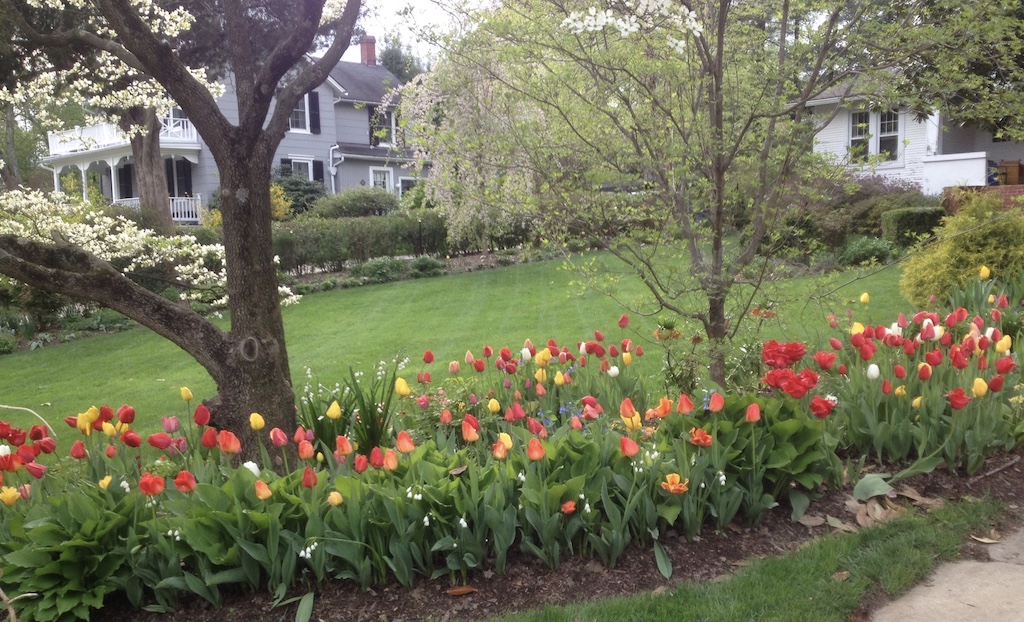
A Treasure Trove of Tulips

By Jean Kaplan Teichroew

If you’ve ever strolled along Grace Church Rd. in the spring, you’ve probably seen colorful swaths of tulips blooming at the edges of the expansive lawn at 1923. Meet the man behind the tulips: Phil Costello has been planting them here every year since 2011. His interest in tulips took root when he lived in London: From his office near Buckingham Palace, he observed the planting of thousands of tulips. He also traveled frequently to Holland, where the flowers have been prized since the 16th century.

Phil starts planting his tulips in late November or after the first frost. He designs and digs trenches and places each bulb individually, this year about 750. (His all-time high is 2,100 bulbs!) Then he covers them with four to six inches of soil. Recently he has hired neighbors David Maya-Shelton and Jayden and Austin Jackson to help in the labor-intensive activity.

A major challenge is foiling predators, responsible for ruining up to 25 percent of the tulip garden. Squirrels dig up bulbs, but don’t seem to eat them. “They taunt me,” Phil laughs, “and then they throw away the bulbs,” leaving them on neighbors’ porches and in their yards. He places chicken wire over the bulbs to deter the pesky rodents and removes it so the tulips can grow when the weather warms. Deer don’t dig up the bulbs, but they do eat the blooms. “It’s constant effort,” says Phil, “vigilance is required.” He jokes that the deer of Grace Church may have changed their eating patterns after he placed signs directing them to a nearby street for better food.

Phil recommends purchasing tulip bulbs from colorblends.com. He also welcomes visitors to his garden. This writer has the advantage of seeing the vibrant flower display from her kitchen window, but you can take in the view come springtime. We’ll look for you on our street.

Wander Under Weeping Cherry

As noted recently by a neighbor on the NWCA listserv

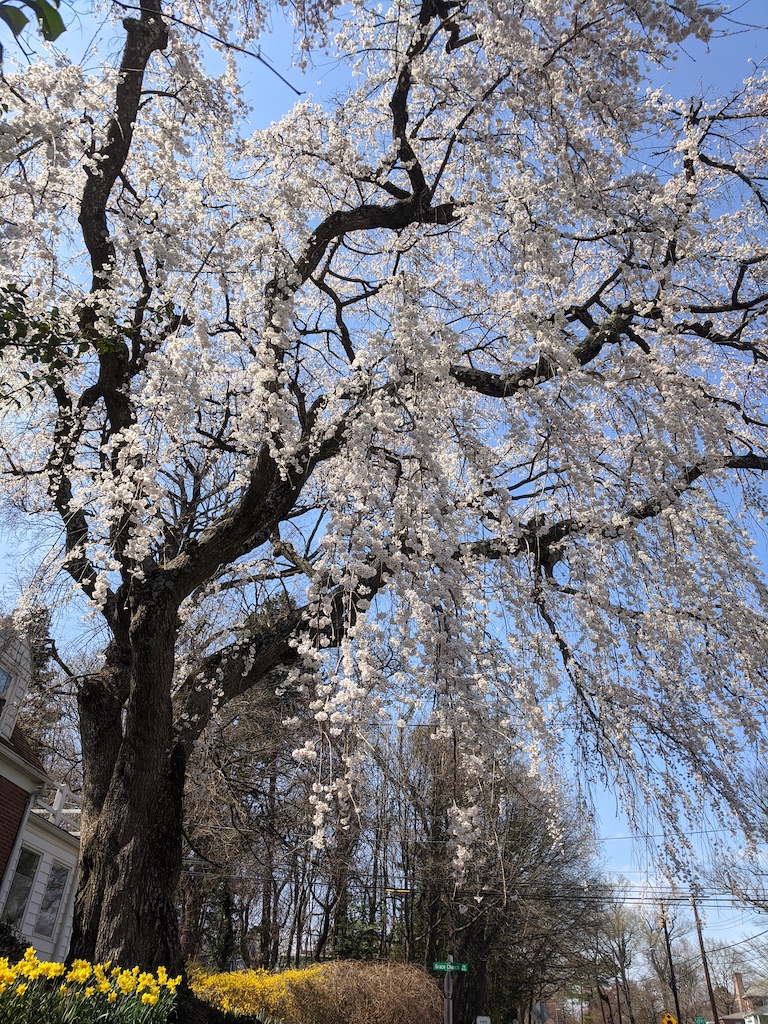
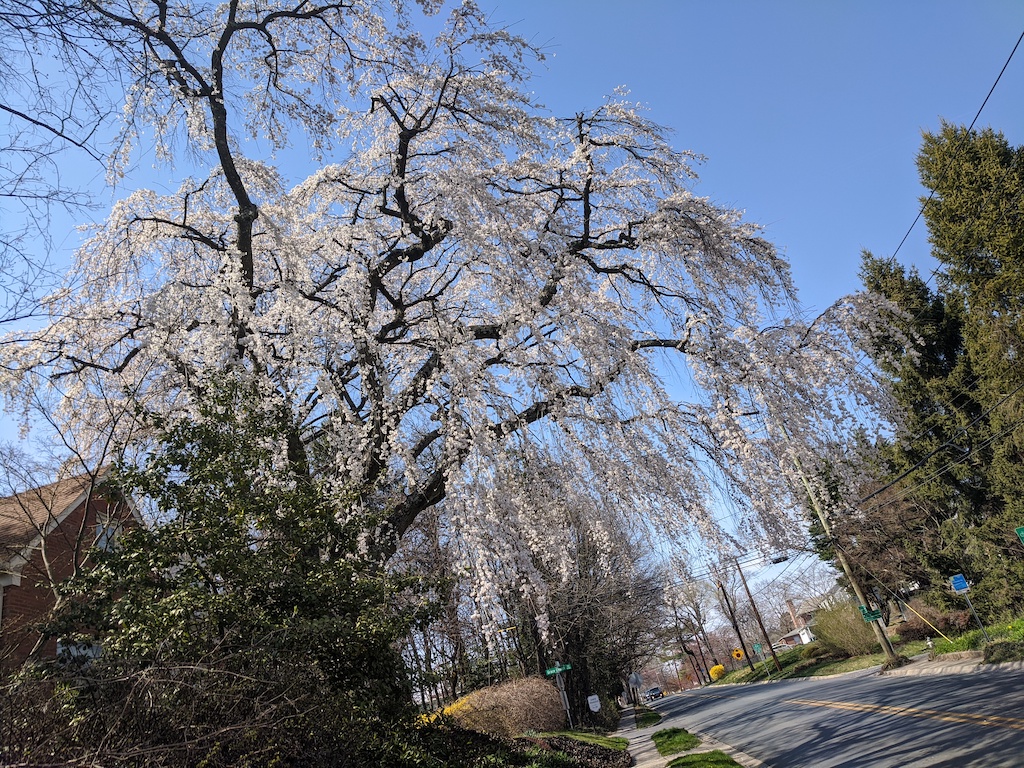
The fabulous, giant, weeping cherry on 2nd Ave.* is in full bloom…. do take time to wander under it…

Want to behold cherry blossoms, but not up for the crowds and traffic around Washington, DC’s tidal basin? Take a stroll under this magnificent tree!

* Between Grace Church Rd. and 16th St.

No doubt a small sapling many a decade ago, the canopy of this weeping cherry now reaches high into the sky, spilling a swaying “bloomfall” of light pink blossoms over 2nd Ave. What young trees planted in North Woodside now will one day grow to great heights and beauty, and grace the path of future generations of neighbors?

If interested in planting a tree in the right of way in front of your house or on your property, contact the NWCA Tree Committee.

Traffic Report

By Jean Kaplan Teichroew

Adding a bump out and a stop sign will convert this intersection to an all-way stop. Image provided by Oscar Yen, MCDOT

The NWCA Traffic Committee and six neighbors met with Oscar Yen, an engineer in the Traffic Engineering Studies Section of the Montgomery County Department of Transportation (MCDOT), on April 13 to review pedestrian safety and traffic-calming measures at key neighborhood
intersections.

Read on for highlights from his summary evaluation and recommendations, which include conducting a speed study on Luzerne near Louis and preparing a work order to add crosswalks with proper striping and/or stop-bar markings at the intersections listed below. (MCDOT will also perform another traffic study for all-way stop controls and other traffic-calming mitigations once Woodlin Elementary School and the Talbot Ave. bridge reopen and heavier traffic resumes.)

Louis and Luzerne
Examine the feasibility of a curb bump out on Louis at the stop sign and trim foliage blocking the stop sign and the east leg approach of Luzerne.

Louis-Glen Ross-3rd-Warren
Build a bump out at the southeast corner of the intersection of 3rd Ave. and Glen Ross Rd. to convert this intersection to an all-way stop control and address the no-stop condition for Warren St.

Luzerne-Louis-Lanier
Create a bump out to reconfigure the intersection to a 90-degree T-shape, and possibly relocate the stop sign to increase its visibility.

Hanover and 3rd
Readjust the crooked stop signs and research a more visible location for the sign on Hanover near the fire hydrant.

Grace Church and 3rd
Add stop-bar street markings to help draw attention to existing stop signs, especially when foliage obscures them.

Talbot Ave. Bridge
MCDOT will conduct a traffic study once the bridge reopens and evaluate for additional traffic-calming measures.

This article first ran in the Spring 2022 issue of the Beacon.

Historical Maps of North Woodside

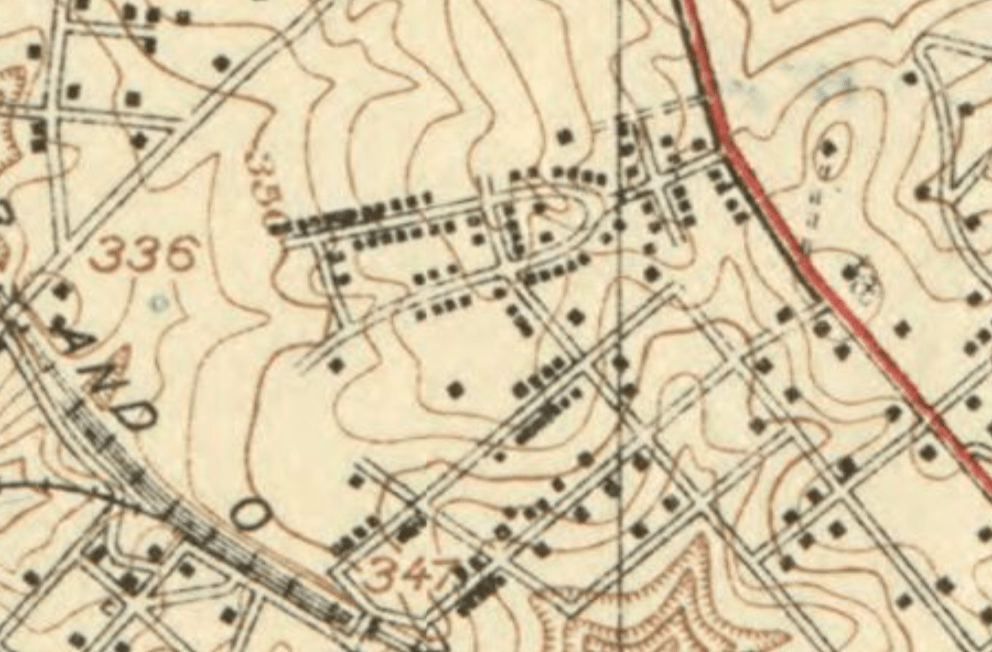
North Woodside in 1929. Source of Map: Library of Congress, Geography and Map Division.

Some links to a bunch of historical maps that show North Woodside in its younger days  (zoom in just above the northern tip of DC to where it says “Woodside”)

  • 1891 (year after our neighborhood was established)
  • 1893 (shows the neighborhood lies ~7.5 miles from White House)
  • 1917 (shows bridge that preceded the historic Talbot Avenue Bridge, built in 1918 and demolished in 2019) Note: if you live in one of the oldest houses in the neighborhood you should be able to find your house on this one.
  • 1918
  • 1924
  • 1929 (#1)
  • 1929 (#2) Note: many more neighbors should be able to find their houses on this one — particularly those living in bungalows and Sears Kit houses on Grace Church, Hanover, Glen Ross, Luzerne, and 2nd.

So interesting to imagine what this area looked like back then. Very little development and no Beltway yet!