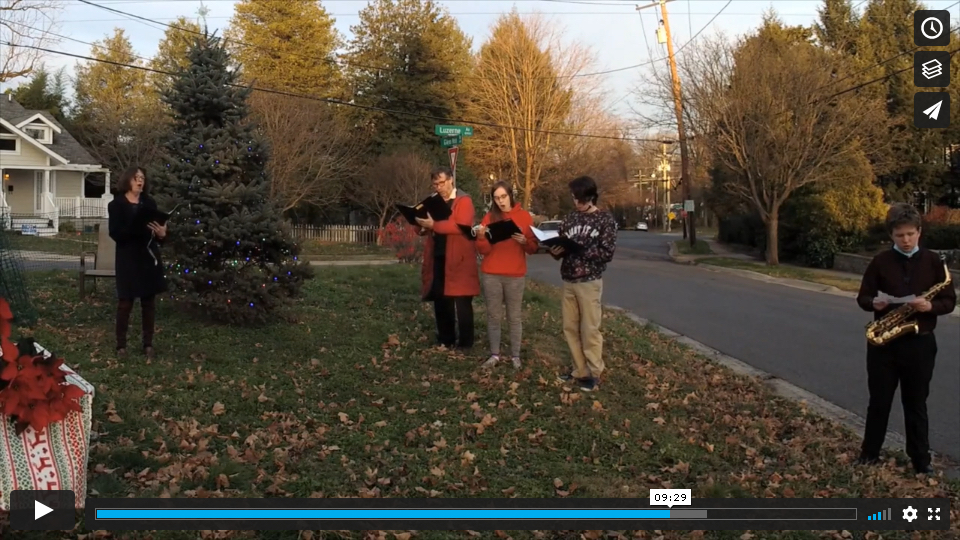
Singing following the lighting of North Woodside’s Community Tree on December 13, 2020
This year’s Tree Lighting program, organized by Holiday Committee Co-Chair Julie Lees, opened with an alto sax version of Let It Snow, followed by a small group of physically distanced singers blending their voices together for Dona Nobis Pacem (Give Us Peace).
After a few words of welcome by NWCA President David Cox, the Community Tree was lit and O Christmas Tree sung. Then it was time for a certain white-bearded man’s arrival to the tune of Santa Claus Is Coming to Town. Neighborhood children came, by appointment, to greet Santa and pick up treats. The event was streamed live and can be viewed below.
Thanks to Snider’s for once again donating a box of oranges for Santa’s treat table.
The Maryland Department of Transportation has announced that it will fully fund the design phase of the Georgia Avenue improvement project.
Despite widespread support of the surrounding neighborhoods, the design and engineering plans for the Georgia Ave improvement project have been stuck at about 50% for almost two years. But due to the determined efforts of NWCA, Friends of Forest Glen and Montgomery Hills, other neighborhood associations, and our elected representatives in Annapolis (especially Delegates Jared Solomon and Lorig Charkoudian), MDOT Secretary Greg Slater agreed to include $1.6 million in the transportation budget to complete design of the project.
The funding could not have come at a better time. It is widely expected that the new Biden Administration will be looking to fund state and local infrastructure projects with an emphasis on projects that improve biking, walking, and transit access. The Georgia Avenue project does all of that.
The intersection road changes came to conclusion in record time due to reduced traffic during the last 10 months. A few items remain:
Montgomery County put in wrongly named street signs. On a walk through the intersection, neighborhood representatives and the county agreed on the correct signage, which should be installed in the next few months. Thanks to Gus Bauman for his help on getting the county to focus on this mistake.
The Linden Civic Association and the NWCA worked together to obtain a sidewalk behind Sniders on the south side of Seminary Place. That sidewalk should also be installed in the next few months.
NWCA is following up on county plans for maintaining the new plants and trees placed around the intersection. Phyllida Paterson of our Tree Committee will be working on this.
Montgomery County arborists are partnering with local nonprofit Casey Trees to offer us expedited planting of free street trees in spring 2021. New street trees are planted in the right-of-way at least 25 feet from existing street trees and 10 feet from driveways. If Pepco distribution lines stretch overhead, trees must be “minor,” or small; otherwise they must be “major,” or shade trees.
Homeowners eligible for new trees may choose a first and second choice of species from a fairly broad list, which includes native species and a range of heights within the tree categories.
Since last year, COVID-related budget constraints have limited the tree-planting budget. Usually the county hires contractors to plant our trees. However in 2020, county arborists began partnering with nonprofit Casey Trees, which planted 15 saplings in our neighborhood (four others are pending) at low cost to the government. This arrangement continues in spring 2021. Casey Trees has provided excellent service to NWCA residents who received their trees, and consistently works hard to increase tree canopy throughout the DC area. Please keep Casey Trees in mind if you are donating to environmental causes this year.
If you think you are eligible for one or more new street trees and want to participate in our group request, contact the Tree Committee as soon as possible. Quantities may be limited. If you have a dead or dying street tree, please call 311 to request removal, which will open space for a replacement in the future.
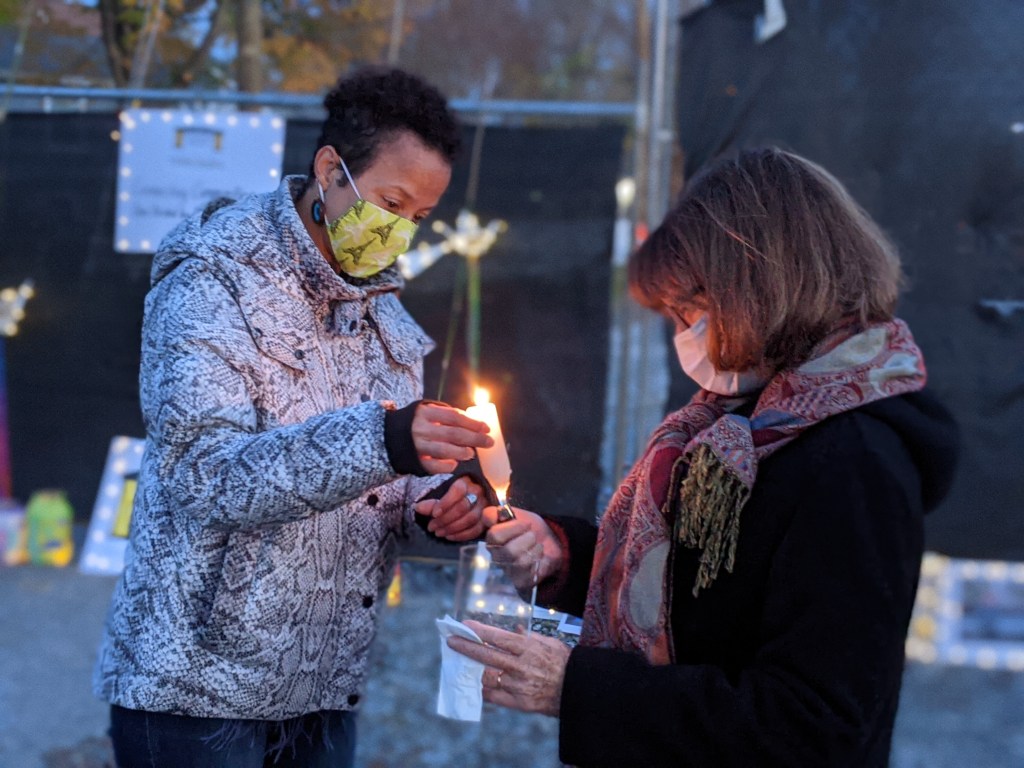
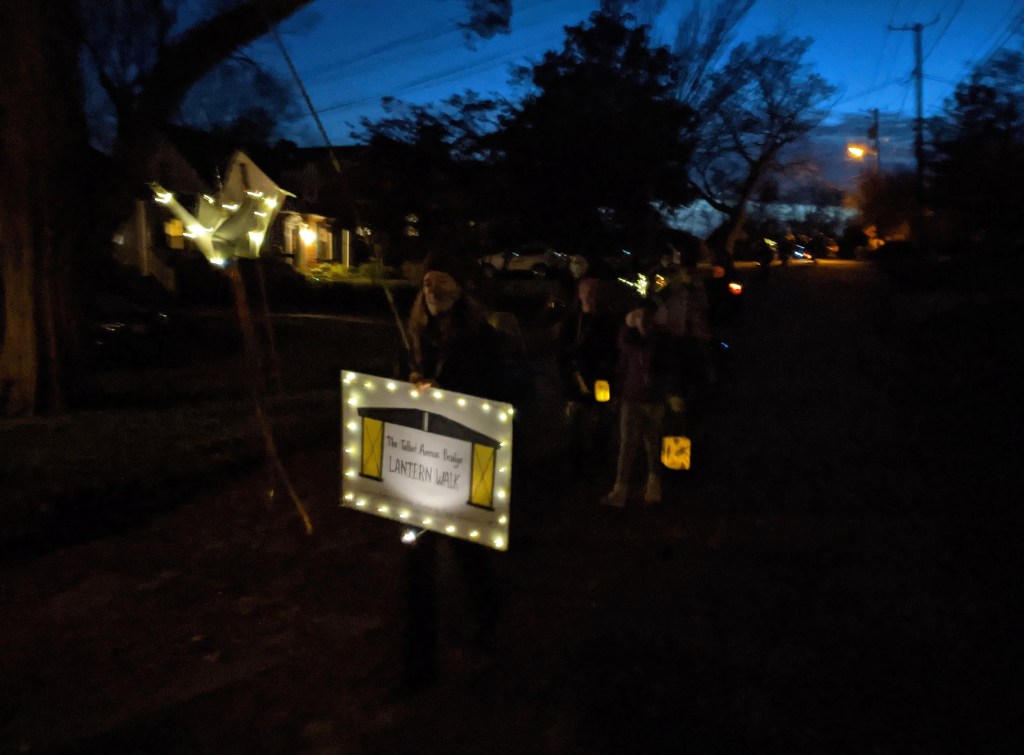
Two North Woodside residents light their lantern candles before the commencement of the 3rd Annual Talbot Avenue Bridge Lantern Walk on November 14, 2020.
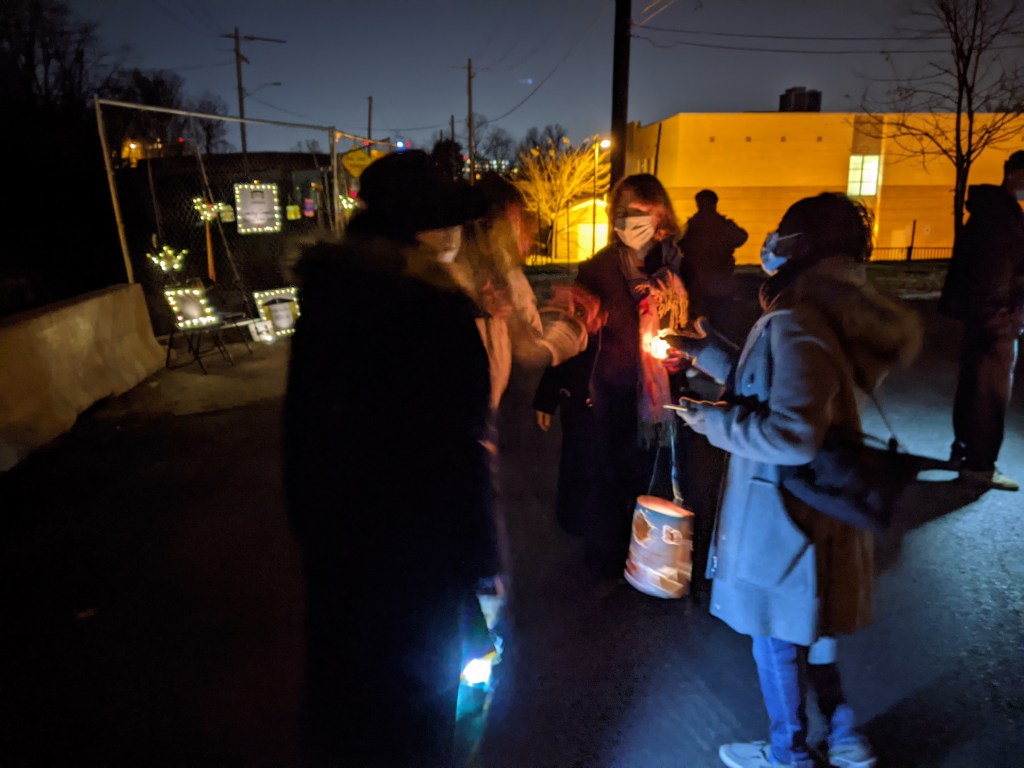
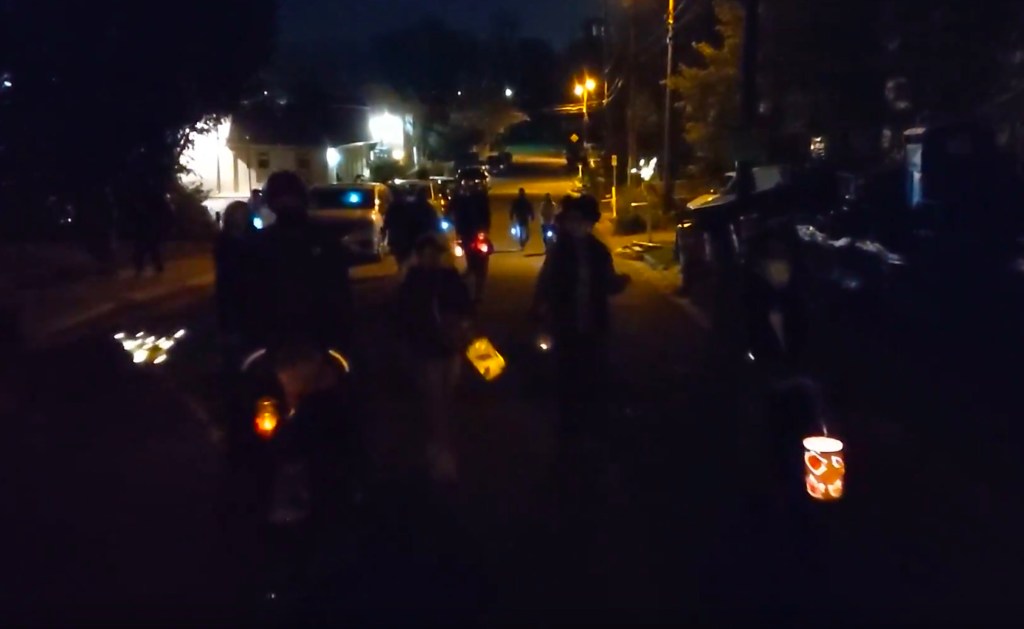
As darkness fell, North Woodside, Lyttonsville, and Rosemary Hills neighbors walked—carrying lanterns, ringing bells, and listening to a recording of This Little Light of Mine—along the mile route from one side of the Talbot Avenue Bridge construction site in North Woodside to the other in Lyttonsville, neighborhoods once divided by racial segregation. Lifelong Lyttonsville resident Charlotte Coffield came out and waved as the procession passed by, and David Cox, NWCA President, and Pat Tyson (Lyttonsvillle) joined those who shared eloquent remarks at the end.
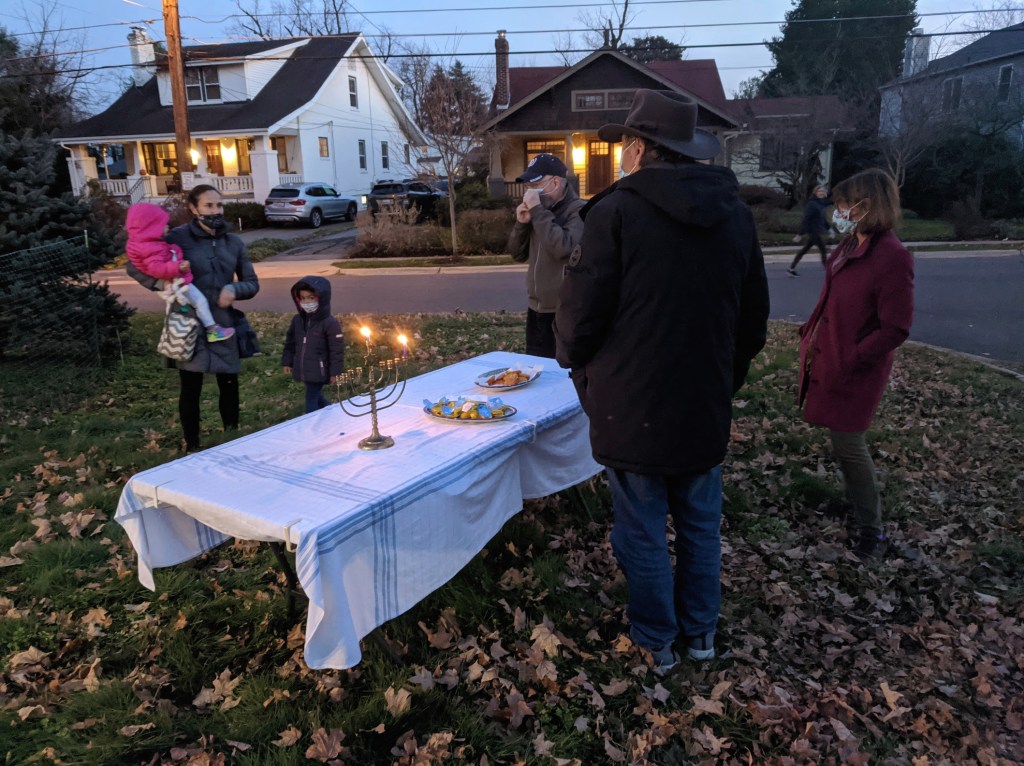
On December 10, 2020, Merrie Blocker, NWCA Vice President, led a traditional lighting for the first night of Hanukkah at the new outdoor menorah on the island where Glen Ross and Luzerne meet. Afterwards, neighbors came, by appointment, to pick up latkes (potato pancakes) and Hanukkah gelt (chocolate coins). The event was streamed live and can be viewed below.
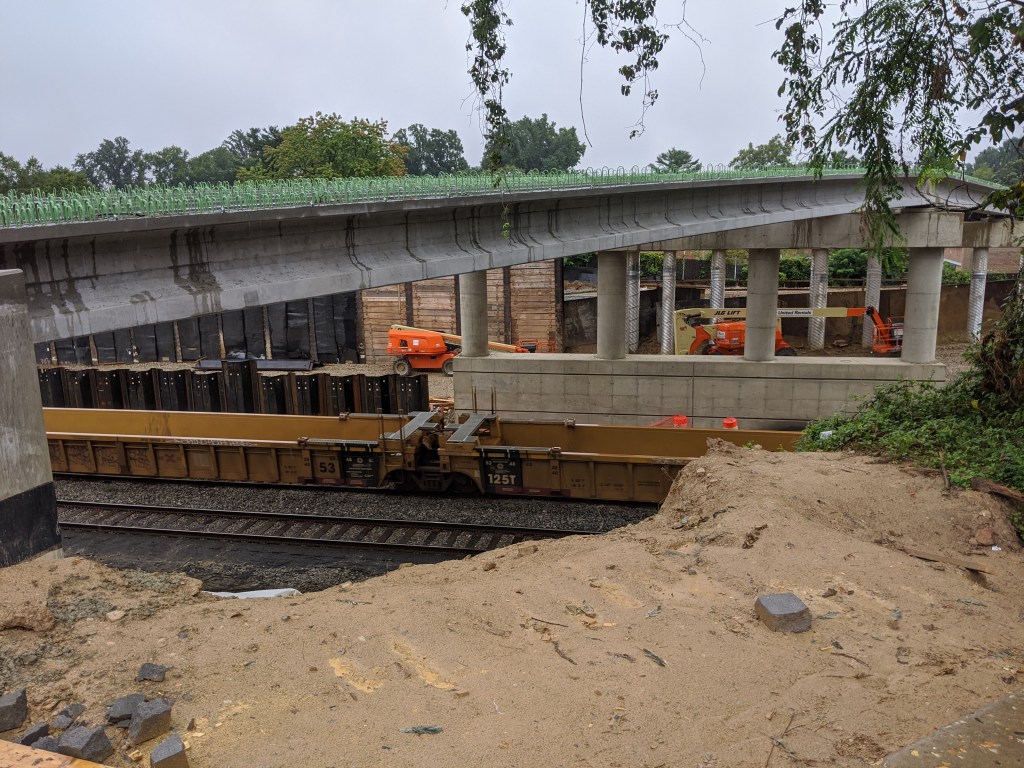
The new Talbot Avenue Bridge in September 2020, before construction halted.
Seminary Road Intersection
The bulk of the road construction work on this project will be completed in early November. Sometime within the next six months, trees and plants will be planted.
The portion of Seminary Road between Seminary Road and Seminary Place, which is now physically a continuation of 2nd Avenue, will be officially renamed 2nd Avenue.
The new traffic lights will be operational in early November and the county will then recalibrate the timing. Also, at that time the new streetlights will begin to work.
Talbot Avenue Bridge
As of Oct. 16, 2020, all construction stopped on the bridge. Due to the inconvenience and the eyesore of the partially built structure, Lyttonsville and Rosemary Hills neighborhood associations sent a letter to Gov. Hogan and other public officials requesting that Talbot Avenue Bridge construction be prioritized in Purple Line activities. After consultation with the members of the Traffic and Safety Committee, the NWCA Board sent a letter of support that also stated the following:
“As we foresee a greatly increased volume of traffic once the Talbot Bridge is opened, the North Woodside Association also wants to take this opportunity to remind Montgomery County, specifically the Montgomery County Department of Transportation, of its commitment, made to us last January and February in a public meeting and follow up emails, that once the Bridge is reopened the County will work with all three of our neighborhoods to mitigate any traffic disruptions.”
We believe that with the support of Lyttonsville and Rosemary Hills, we will obtain the traffic mitigations we’ll request in the future.
The approval of almost all types of mitigation requests is based on traffic-volume studies. So it would be wise to wait for the bridge to be open a few months and for the pandemic to have passed before requesting such a study.
2nd Avenue
Residents on 2nd Avenue have concerns about traffic speed and volume, particularly regarding pedestrian safety. The Traffic and Safety Committee will follow up with the county to request a review of all options for better traffic control and pedestrian protection.
— by Merrie Blocker and Julie Lees, Co-chairs, Traffic and Safety Committee
The COVID-19 pandemic is disproportionately hurting low-income and Black and brown families, whose adults are overrepresented among essential workers. Their children, especially the younger ones, are falling further behind academically.The new Educational Equity and Enrichment Hubs provide a safe opportunity for in-person support for MCPS K-5 students, based on financial need. Learn more here: www.equityhubs.org.
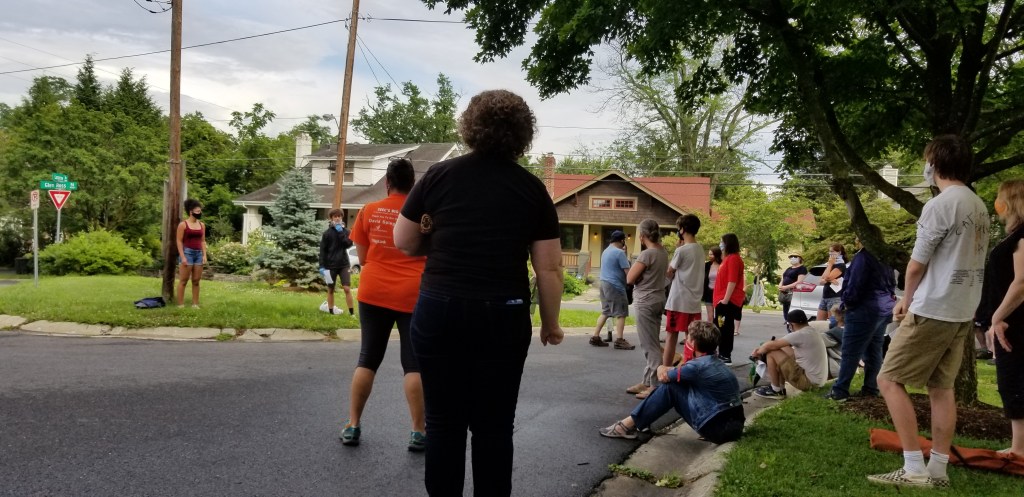
In June, Avery Smedley and Luca Utterwulghe (above at left), seniors at Albert Einstein High School, led a well-attended community conversation on racism.
By Isabel M. Estrada Portales
Let me run a couple of scenarios by you. Raise your mental hand if they seem familiar.
You consider racism abhorrent and often tell yourself and others that you don’t see race.
You want to acknowledge the contributions of Blacks, so every February you assign your students readings from Black authors, attend the Black History Month celebration at work, and talk to your children about it.
You like diversity in schools and neighborhoods because it prepares kids to deal with a world full of people of different races and ethnicities.
Keep these scenarios in mind and read on.
This summer, amid the anguish and rage that peaked with the murder of George Floyd at the knee of a police officer, our neighborhood’s kids did us proud. Luca Utterwulghe, 17, and Avery Smedley, 17, both of Luzerne Ave., called a meeting to discuss how our community can support the needed transformation for racial equality and justice in our country and county. Above their great advice, we heard a question anyone with kids has heard before: “Are we there yet?”
Avery Smedly, the President of AEHS’s Black Student Union and the founder/leader of Montgomery County Students Toward Equitable Public Schools (STEPS). Luca Utterwulghe, also part of STEPS, is a co-leader of AEHS’s Montgomery County Students for Change. Naomi Weintraub, a youth educator, also helped organize the event. This section incorporates information from a handout they distributed.
In the car ride of racial equity, their impatience with our slow driving is justified. To speed things up, they call on us to be antiracists by actively identifying and eliminating racism through changes in systems, organizational structures, policies, practices, and attitudes, so that power is redistributed and shared equitably.
Think about the scenarios above. If you don’t see race, can you see racism? Can you notice if your workplace’s hiring practices keep people of color out even unintentionally?
If you don’t see race, do you consider the potential dire consequences before calling the police on a Black person? Do you wonder what made you think the police were needed?
In your syllabus, are all the Black contributions crowded in February? Do you solicit Black expertise only about racial matters?
When you think about diversity, is it your kids or their kids you are thinking off? Is it hard to hear that kids of color are not “training wheels” for when white kids graduate to the “big bike” that is the world? What else would you do to achieve that diverse environment? Would you move to a mostly Black neighborhood? You say those schools are bad? Why? And why should income and zip code determine the quality of kids’ education?
We try to do right, but as our exasperated kids tell us, waiting for the arc of history to bend towards justice is taking too darn long. We need new approaches and changes at every level. Some of it begins by talking about things that hurt. (Trust that none of us, including people of color, find these conversations easy.)
Even our language needs to change—why capitalizing Black is meaningful—to confront and unlearn racist mindsets to act in accordance with our values.
Hear out Black people when they bring up issues and actions that you might not have thought were racist. People of color don’t often expect racial slurs in this neighborhood, but inadvertent slights are all too common.
Let friends and family know that neighborhood schools give us an immediate opportunity for committed antiracist action. We can support equity-focused and antiracist policies at the county level and at the Board of Education. Begin with advocating for the pending district-wide boundary analysis.
You can email MCPS Board members to call for police-free schools. The presence of police is experienced quite differently by Black and brown children. Use the hashtag #CounselorsNotCops.
Let’s start having difficult conversations in small groups or one-on-one. Are you concerned about any of this? Have you had a negative experience with a neighbor or passerby? We can talk it out as neighbors and fellow citizens. If we can’t talk to the people who live nearby, our chances as a country are slim.
There is a lot more, but how about we just talk? Contact Isabel.
Quite a few years ago North Woodside had a rash of burglaries, and the citizens association held a meeting with the police department at Woodlin Elementary School.
A detective suggested we call the police if we saw someone we didn’t recognize walking down the street. I felt pride when my neighbors objected to the suggestion on account of the many people who cut through Glen Ross and Luzerne to their jobs on Brookville Road.
We often see people we don’t recognize, and even then we knew that calling the police would make our neighborhood hostile and dangerous for many who are just trying to get to work and school. His advice would mean that mostly white neighbors would make miserable the lives of mostly Hispanic and African American men.
Afterwards, I felt confident that we were not a neighborhood where the police are called with little cause. It’s been many years since that meeting, and we may need to rethink this issue.
With the pandemic shutdown, I’ve noticed a big uptick in people taking walks. Many of them I do not recognize, but of course most working people were not taking walks midday before. I suspect that, just as I’ve been doing, more people are walking farther afield and venturing into new neighborhoods.
As a middle-to-older-age white woman, I’m pretty much invisible (I can prove it!). There are downsides to that, but one upside is that no one calls the police or posts on Nextdoor “old lady in sweat pants walking around, keep an eye out.”
I’d like to think that everyone gets the same courtesy.
People may not like to hear it, but we are an urban suburb. We have enormous infrastructure supporting us — sewers, trash pickup, two Metro stops within a mile, and a major state road and federal highway within a few blocks. Walk to the end of Grace Church Road and look east — you almost think you could throw a ball at the Silver Spring high-rise buildings.
The flip side is traffic (remember that?). But a huge advantage is what we may love about our quiet tree-lined neighborhood: we know and like many of our neighbors; we can walk to grocery stores, restaurants, movies; and transit takes us to museums, more restaurants, and the political heart of our country.
So we may like to feel secluded from the bustle of the world, but we are right next to it. Many people walk through our neighborhood, and that will vastly increase if the Purple Line is finished. I think that’s great.
I want to live in a neighborhood others choose to walk through because they like the flowering trees and beautiful gardens, the dogs in the yards, birds building nests, and interesting architecture.
I don’t want to live in a neighborhood hostile to people of color, where the police get called on them just for walking down the street, or where emails fly around warning of a “man in a hoodie.”
Our nation has been forced to face the role police play in keeping African American men, women, and children from enjoying their rights as full citizens in a country largely built on the labor of their forebears. And we have seen far too many videos of white people using the police as weapons against African Americans (think Amy Cooper in Central Park).
I hope we think more than twice about why someone arouses our suspicions. Until police procedures are reformed, we must understand that calling the police could result in death or serious injury. We might want to think that couldn’t happen in Montgomery County. But it has. And it probably will again. Let’s try not to be the ones making an unjustifiable call with unforeseeable consequences.

 Welcome to North Woodside