Steps in the Chain of Title Search Process (Montgomery County, MD)

By Kirsten L. Crase, PhD

The best place to begin your chain of title search is Montgomery County Atlas.

  1. Enter the property address in the box at the top: A map identifying your property within its neighborhood context will appear.
  2. Double-click within the boundary line of the property (zoom in first, if necessary), and a box showing basic property details will appear (owner, land use category, assessment date, year built, etc.).
  3. Click on Data Description at the top of the box for a brief description of each piece of data listed; of most importance are the liber and folio numbers. This set of numbers constitutes the first deed in your chain of title.

Your next stop is the Maryland Land Records Database. You’ll need to submit a request for an account before you can access the database. Once you have your account and the liber and folio number for your property’s current deed, you can begin searching. It’s always best to start with the current deed, even if you’ve identified previous deed information.

  1. Select your county (Montgomery) from the upper-left drop-down menu.
  2. On the search page that opens, search using the top box, titled “Jump to New Volume,” searching via liber and folio numbers.
  3. Skipping the Clerk box, enter your liber number in the Book box and your folio number in the Page box.
  4. The deed document that opens will be the current deed for your property, which should list the current owners as the grantees (buyers), along with the grantors (sellers). It will provide the date of the property transfer and a description of the property, often including the lot number, block number, subdivision name, and the location within Montgomery County Land Records of the document recording the original platting of the subdivision within which it is located. (For example, “…the west 50 feet in width of Lot No. 3, in Block No. 20 by the full depth of 150 feet, in the subdivision of land known as and called B.F. Leighton’s Addition to Woodside, as per plat recorded in Plat Book A, Plat No. 60.”)
  5. With this information, you can visit plats.net. Start by selecting Montgomery County in the drop-down menu, and when the Basic Search box appears, enter the plat book number and plat number in the appropriate boxes. You should see the name of the appropriate subdivision and a hyperlink to an MSA (Maryland State Archives) accession number. Click on this link, and you will be taken to the original platting record of the subdivision (usually a map of the subdivision) within which your property resides.

At this point you know the starting point (current deed) and ending point (subdivision platting) of your chain of title, but you must fill in all the deeds in-between. To do this, return to mdlandrec.net and begin working your way backward from the current deed.

In the current deed, somewhere below the property description, there may be a paragraph that notes the liber and folio number of the previous deed. If so, return to the search page and enter this information, and continue following this process until you reach a deed that does not list the previous deed’s information. Unfortunately, this may happen at almost any point in the chain of title search.

When this happens, return to the main Montgomery County Land Records Indices page.

If the oldest deed you locate is from 1977 or later, click on “Individual Search” or “Corporation Search” in the left-hand column. This is a straightforward search process that involves entering the name in question and the date parameters.

If the oldest deed you locate is from 1976 or earlier, click on “Active Indices” in the column on the left. Since the grantee name is the only name you know at this point (i.e., the grantor on the oldest deed you’ve located), click on “Land Records, Grantee Index, 1777–1976” in the drop-down menu. Then choose which block of dates you want to search within. Begin with the most recent block of possible dates for the deed you’re searching for; for example, if your earliest known deed is dated March 5, 1975, begin with the indices from 1973–1977. Under this block of dates, look for the first letter of the owner’s surname, or corporation name, and then the first letter of their given name. Once this page opens, click on the red hyperlink on the right — “How to Use Montgomery County Land Record Indices” — for an overview of the process used to continue your search from here. Once you find the next-oldest deed, the previous deed’s liber and folio numbers may be listed here, but if not, repeat the process of using the Active Indices search option (or Individual/Corporation search, if it’s still later than 1977) to continue to work backward. You’ll know you’ve reached the end of your chain of title when you locate the deed in which the name of the grantor is the individual or corporation that platted the subdivision in question.

How-To: Historic Newspaper Research

By Kirsten L. Case, PhD

The local “newspaper of record” for many decades.

The most user-friendly source of historic newspapers is the Library of Congress website “Chronicling America” (chroniclingamerica.loc.gov), which provides free access to a searchable network of digitized newspapers from across the country. The Advanced Search tab allows you to select a specific state, or the District of Columbia, to search within, and gives you multiple options for key word searches.

For Montgomery County, it is always a good idea to try each search in both Maryland and the District of Columbia. The “Evening Star” (Washington, D.C.) was considered the newspaper of record for many decades, and it is also a wonderful source of social news for the city and the surrounding counties. The “Montgomery County Sentinel” is another important local newspaper in the database.

Editor’s note: If you would like to be part of an organized approach to neighborhood history research — or if you come across any interesting information related to neighborhood history that you’d be willing to share with neighbors — contact the North Woodside History Group.

Digging into Neighborhood History

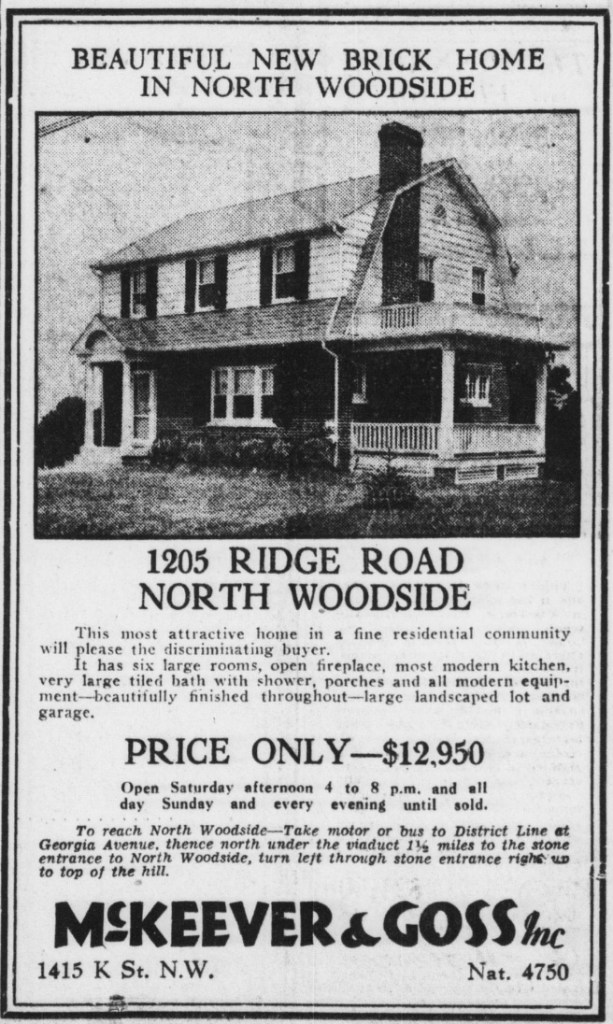
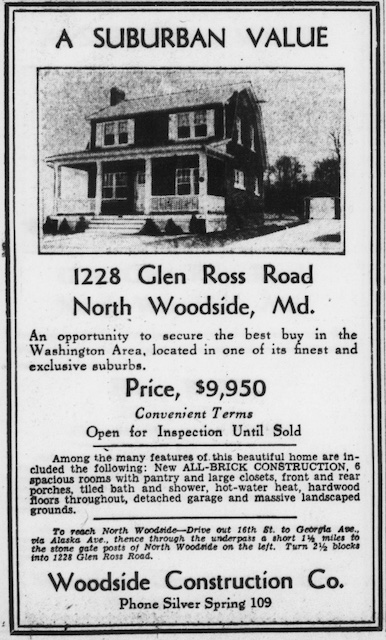
On February 16, 2022, many neighbors tuned into an online training by Kirsten L. Crase, PhD, University of Maryland, on how to research the history of their homes. The training inspired a search of historic newspaper digital archives for articles related to the neighborhood. Among many fascinating finds, neighbors uncovered a plethora of original advertisements for North Woodside homes. Can you find these homes today?

Source: Evening Star (Washington, D.C.), Chronicling America: Historic American Newspapers. Lib. of Congress. Dates/Pages (left to right): September 15, 1928, Page 23; August 21, 1936, Page 16; September 6, 1930, Page B2; April 25, 1931, Page B2.

Many of the old North Woodside advertisements, such as the large one above, tout the
“exclusive” nature of the community and “the protection of its sensible restrictions,” not-so-subtle allusions to racially restrictive deed covenants.

For more information on researching the history of your home:

And if you discover your home has a racist deed covenant:

Letter from the President

Genevieve McDowell Owen

By Genevieve McDowell Owen, NWCA President

Personally, I’m not a fan of change. Snider’s, under the new ownership, still feels a bit weird to me every time I go in; I miss our neighborhood Staples even though Aldi replaced it some time ago; and I’m still adjusting, almost eight months later, to being an empty nester. Plus I can’t quite believe houses in North Woodside are now selling for a million dollars, some for over a million dollars. Maybe your house is worth that already. Wow. Can I mention that my husband and I bought our house in 2000 for $217,500? I don’t think our modest bungalow is worth $1,000,000 quite yet, but it’s now worth so much more now than I ever imagined it would be.

So change has already come to North Woodside. We are at the center (okay, technically bottom center) of a growing, affluent county bursting with new folks bringing innovation and eagerness to succeed right to our doorstep. But this boon is creating a big problem — lack of housing. It is one of the reasons our houses have increased so rapidly in value. Everyone wants to live in North Woodside. (And why wouldn’t they? It’s lovely, and close to shopping, good schools, and transportation.)

According to a recent Washington Post article, “(t)he supply shortage has grown so severe across the D.C. area that, in 2019, the Metropolitan Washington Council of Governments issued a sweeping call for local leaders to aggressively ramp up housing production. The association advised governments to approve a total of 320,000 homes by 2030, with a focus on affordably priced housing near jobs and transit.”

So Montgomery County has decided to embrace this population growth — it’s already proved to be a boon to our area, economically and culturally — and even plan for it. Because without a plan growth can cause problems, of course. It can strain services, increase commute times, worsen environmental conditions, and exacerbate inequality.

The plan, created by our Montgomery County Planning Board, is called Thrive Montgomery 2050 (Thrive). Maybe you’ve heard of it? It’s a 30-year blueprint for population growth in our county that also addresses environmental and climate concerns, transportation, open-land preservation, quality-of-life issues like walkability and public art, and the pressing need for racial equity and social justice. If you’re not familiar with it, check out the Thrive section on the montgomeryplanning.org website.

I was delighted to be part of the team of NWCA Board members that brought together lots of folks with different perspectives to discuss the housing and zoning aspects of Thrive, and what changes it might bring to our corner of the county, at a neighborhood forum back in March. After planners from the Planning Board presented a quick outline of Thrive, North Woodside residents asked excellent questions of the six panel members representing all sides of the issue.

I was even more delighted that the neighborhood survey on Thrive, sponsored by the NWCA Board, garnered a record-breaking response, with 111 neighbors representing 99 households participating (a nearly 40% increase in individual participation — and at least 25% by household — compared to the last survey we conducted in Fall 2019). The results of the survey, which are available on our website, showed that a majority of the neighbors who took the survey support the way the county proposes to plan for the future.

Thrive Montgomery 2050 is still under review, and won’t be voted on by the County Council for a few more months (so there’s still time to make your voice heard!), but even before a plan is put in place, I’m grateful to live in a county that is committed to creating a green, just, and inclusive way to deal with a future of growth and change. It makes thinking about the coming changes easier for me, including the addition of much-needed housing to our area. I hope it does for you, too.

The above letter ran in the Spring 2022 issue of the Beacon.

Neighbors Create Mosaic Path

Under the inspired leadership of Bertie LoPiccolo, neighbors and friends gathered on an unseasonably beautiful President’s Day to help Julie Savage and Keith Carlson lay a mosaic path leading to their newly built backyard ADU (accessory dwelling unit).

“I dreamed of building a healing, welcoming ADU space for my small therapy practice and imagined a whimsical, joyful path leading up to it — a piece of community artwork that would bring people together. Bertie caught the vision and made it happen, with the added expertise of Suz Podrasky and many first-time mosaic artists.

Close up of a mosaic flower

In the days leading up to pouring the concrete, I gathered small mosaic creations from anyone who had any inclination to contribute. (Thank you to so many in the neighborhood!) The finished path is a magical collection of birds, bugs, trees, words, a cicada, rainbow, sun, moon, small house, and so much more.

Feel free to come to 1914 Grace Church Rd. and check it out anytime. In challenging times, I hope it will be a reminder of all the good that is possible when we come together in new and beautiful ways.”

— Julie Savage

The finished mosaic path!

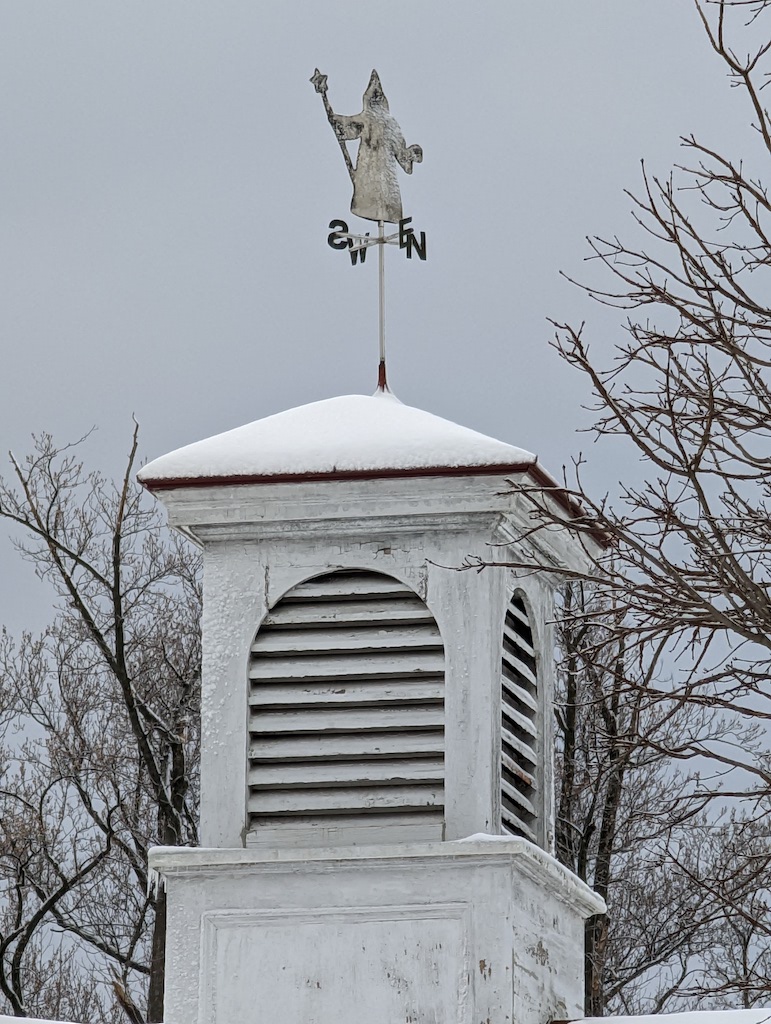
Story of the Woodlin Wizard Weather Vane

By Phil Termini

Skip back to end of the school year 2002. What happened to the Woodlin Wizards weather vane on the cupola atop our elementary school? It seems to have vanished! Bummer, “the pump don’t work cuz the vandals took the handle.”

My and my wife Patricia’s son Tony was finishing his last year there, and our two daughters attended there as well. So I got the notion to try to do something as a tribute for the school and the wonderful principal, Emily Kesser, like making a new weather vane to replace the one taken by the vandals. Having been around the block a few times in my youth, I had an idea. Signs went up around the area offering a no-questions-asked $100 cash reward for the weather vane’s return or its simply being put in our yard. Wishful thinking. No takers. These kids today don’t need any money. Too affluent a neighborhood, I suppose.

I learned that the Woodlin PTA was instrumental in getting the first Wizard weather vane made by a local metal artist, David Hubbard. I visited David and lo and behold, he still had the original full-size drawing of our Wizard. Piece of cake!! I got ahold of some stainless steel sheet metal and started cutting and welding. Metalwork is one of my hobbies—go-carts and minibikes and such. When I installed this new Wizard on top of the school—completely ignoring what the school maintenance staff said to me about going up on the roof (it’s my nature)—where it now lives, I got advice from metalworkers on how to install it in such a way as to make it just about impossible to steal again. One-way screws and a detent in the shaft did the security trick. I may have to go back up there to remove it for the rebuild if the contractors and construction personnel can’t handle it. What a fine old Wizard we have. I hope the new school has a spot planned for it.

Beacon Editor’s note: Woodlin Elementary School’s PTA President reports that the school’s cupola (including the weather vane) is to be incorporated into a “learning lawn” that will face Luzerne Ave.

Delivering the Mail Through Rain, Shine, Snow, and Covid

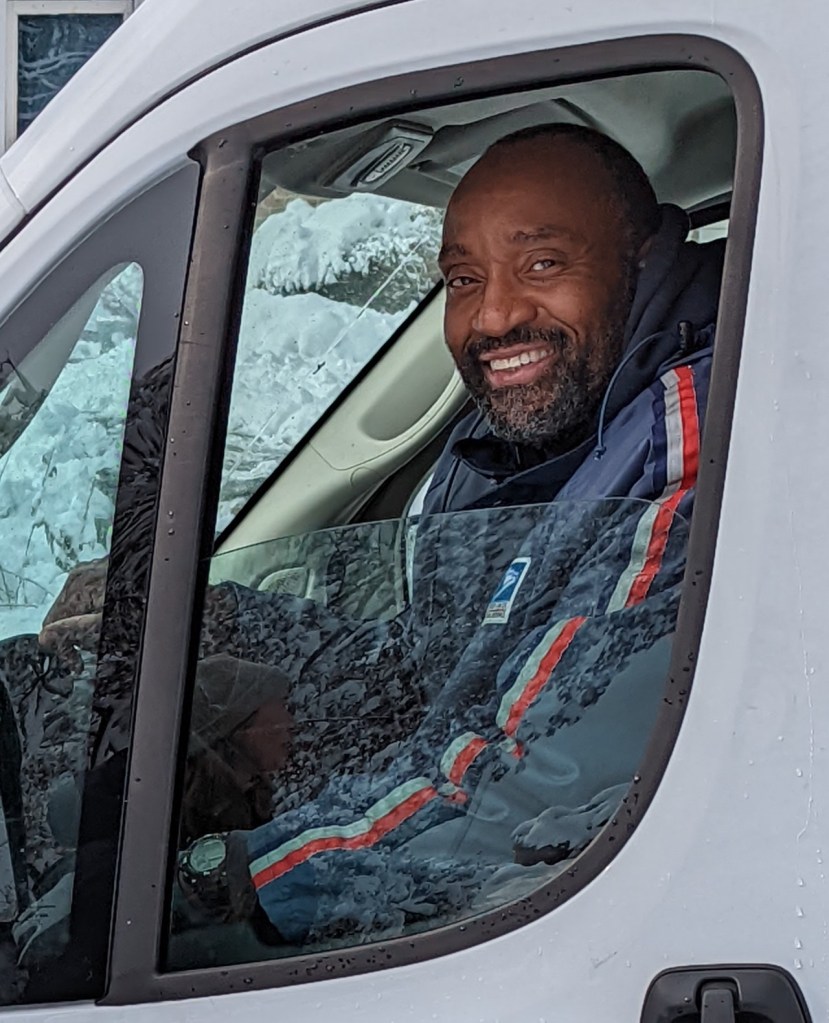
Anthony delivering mail in the neighborhood on a snowy January day. Photo by Lilian Pintea

An Interview with Anthony St. Hill, USPS Postal Carrier
by Anna White

If you live in the neighborhood, particularly on Glen Ross Rd. or south, there’s a good chance you’ve crossed paths with Anthony St. Hill, a USPS postal carrier who has delivered mail to the neighborhood for almost 15 years—as a one-day-a-week replacement carrier for over six years and then full-time for the past eight. He is one of two postal carriers who serve North Woodside full-time; the other is Marqueze Bradley, who has delivered in the northern section of North Woodside for three years. Known for his conscientious service, Anthony knows by heart the names and addresses of all the neighbors—human and canine—along his route. In January, he graciously agreed to a phone interview on his one day off.

What is a typical workday and workweek for you?

On a regular day, we deliver packages and mail simultaneously. Only during Christmas season do we deliver earlier. Then we come in at 5:00 am and deliver packages until 8:00 am. My normal route starts at 7:45 am and goes to 4:25 pm—that’s my regular eight-hour day—but every day we have an additional two to three hours. I work six days a week. For regular carriers, the only day off is Sunday.

Do you get overtime pay?

Yes, we do get overtime because we are unionized. We get overtime after eight hours and then after 10 hours, we go into penalty time, which is double. We work anywhere from 10 to 12 hours on a daily basis. And with this COVID and stuff it’s even worse. Sometimes we have 10 to 12 carriers out sick, and then we have to cover those routes because the mail and the packages have to go there every day.

COVID has impacted your work?

At my station now we have about 10 carriers out. [Last year] it was the same way, and I was out. At the beginning I thought it was pneumonia, but when I got tested I was positive. Some of the people who worked next to me tested positive and management never told me, so then I was out almost the entire month of January 2021. With COVID it makes [the job] more strenuous, working longer hours on a daily basis, due to packages increasing with everyone ordering online and covering coworkers who are out sick.

What do you like about working in the neighborhood?

I love working in the neighborhood. For me, it’s like a family environment because I know each and every tenant on my route and they know me. I start at 2nd Ave. where the nursing home is and cover 2nd Ave., Hanover, Glen Ross, Lanier, Grace Church, Elkhart, 16th, the townhouses on Lyttonsville, the high-rises—all that is my environment. The families know me, the kids they know me, even the pets know me. I love my route because I love my tenants. They look out for me, and I look out for them. Most of my customers have access to my phone number. When they don’t see me for two or three days they call me to make sure I’m okay, on vacation. Is there any way neighbors could make doing your job easier? If you have a dog [that stays outside] put your mailbox at the curb to avoid any dog biting, because dogs are by nature territorial. That’s the only thing I would say. If the dog is inside, no problem. Most biting happens during summertime and other times when children are on break; children like to run outside to play and [forget] to close the storm door. If you are expecting mail, make sure your dog is inside.

Any interesting stories related to delivering mail in the neighborhood?

There are dogs I have to say hi to. When the owners are walking them and they pick up my scent I have to say hello to them or just pet them or they will not continue. And those are big dogs—Chula, she’s a pit bull. She lives in the high-rise. Anytime the owner walks her, she says, “Chula becomes a puppy when she sees you!” I have to pet her or she will not let the owner carry her anywhere else. Then I have Luna, on Lanier. She’s a husky with blue eyes. Same way. I have to say hi to her or she will not move. And I have Charlie. I have to say hello to him every time [or he] will keep barking and barking. People ask me, “You not afraid of dogs?” No, I grew up knowing dogs. I know about dogs. [The dogs on my route] are like extended family. Have to say hi to them or they will not continue their walk.

Is there anything about yourself you’d like to share with neighbors?

I was born in Panama, and I dance my national music. That is what exposed me to the world. My first travel outside of my country was [through dancing]. I used to perform on a ship in the Panama Canal from 1984 all the way to 1999, when I came to the United States. And I still perform my national music. I was one of the top dancers when I used to perform in my country. And I still perform here. I like it. I love it. I retired from dancing for six to seven years, but I started dancing again.

Anything else?

Like you to know I’m married, I have five kids, four grandbabies. That’s basically it. I’m a very religious person. I’m a faith Christian. God is the center my life. I’m Episcopalian. I usually go to church every Sunday. Only Sunday don’t go to church when I have to work. Other than that in church every Sunday. And that’s it. That’s who I am.

UPDATE: September 9, 2022 is Anthony’s final day delivering mail in the neighborhood. If you would like to express your appreciation to Anthony for his many years of excellent service, contact the NWCA Communications Coordinator for more information.

Neighborhood Forum on County Housing Issues

By Genevieve McDowell Owen, President

Have you ever wondered “so what, exactly, is a ‘zoning text amendment’ and how might it affect me?” Or maybe you saw some posts on the neighborhood listserv about Thrive Montgomery 2050 and would like a better understanding of what it means for our community. These and other questions will be answered at a Zoom forum on February 6 at 7 pm. The NWCA Board invites all neighbors to join us for this informative 90-minute virtual neighborhood meeting.

The meeting will start with a brief, factual presentation on current county housing issues and initiatives, tailored to address specific questions submitted by you and your neighbors,* by Montgomery County Planning Board Project Manager Khalid Afzal. Then the meeting will move on to a balanced panel discussion featuring knowledgeable local folks with different perspective on the issue who will answer more neighborhood questions. Scheduled to participate are local real estate expert Liz Brent, founder of Go Brent Realty; President of the Montgomery County Civic Federation Alan Bowser; the Maryland Advocacy Manager for the Coalition for Smarter Growth Jane Lyons; and longtime North Woodside resident Gus Bauman.

The link to the meeting will be posted on the listserv. Any neighborhood residents who wish to attend but don’t have access to the listserv, please contact the board’s President or Programs Coordinator.

Flat Tire-Repair Workshops

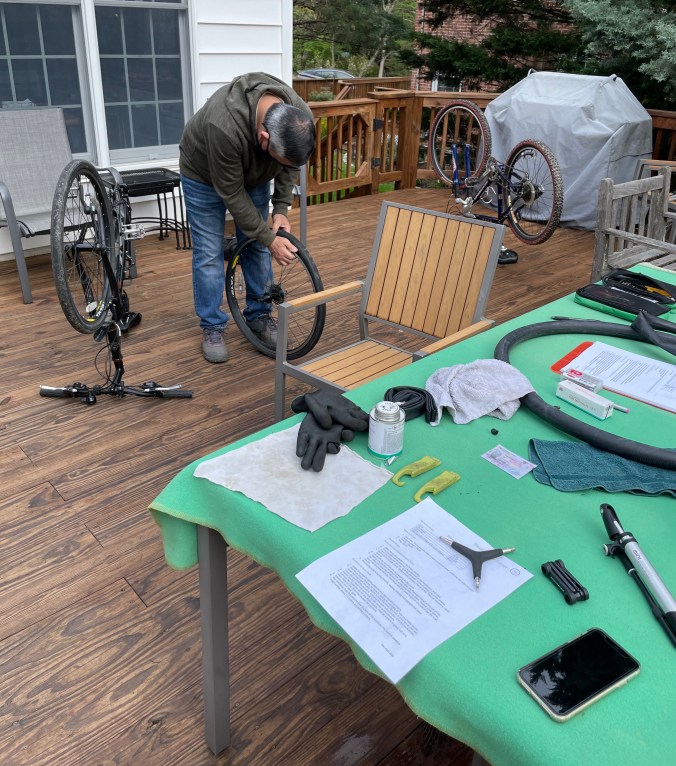
A flat tire is one of the most common mishaps that can occur while riding a bike. A piece of metal, glass, or even a thorn can end an otherwise enjoyable ride. I am offering a free hands-on workshop to show you how to repair a flat tire while on the road or trail. At the end of the two-hour session you will know how to remove a damaged wheel, identify the cause of the flat, locate the puncture, repair the inner tube, and what basic tools you should carry to take care of such an emergency. All materials, including patches, cement, practice tubes, and written step-by-step instructions will be provided.

Sessions will be limited to two participants, ages 16 and up, and will be held outdoors on my deck with plenty of spacing between us. Masks will be required. Bring your bikes to practice removing a wheel and mounting it when the repair is completed. We will practice patching a puncture on inner tubes that I provide. I plan to hold these sessions through the spring and summer. If interested, please contact me to schedule our workshop.

–Manuel Vera

Kudos to Manuel who has serviced a whopping 98 bikes for free since April 2020 and fixed up and given away 32 donated bikes!

For more information about Manuel’s bike tune up services and bike donation project:

A pandemic project: Fixing up bicycles and giving them away free
by John Kelly, Washington Post, May 4, 2021

NPR: Retiree Finds Purpose Restoring Unwanted Bikes, Gives Them Away
NPR, Morning Edition, May 6, 2021

Get Ready to Order: Food Trucks!

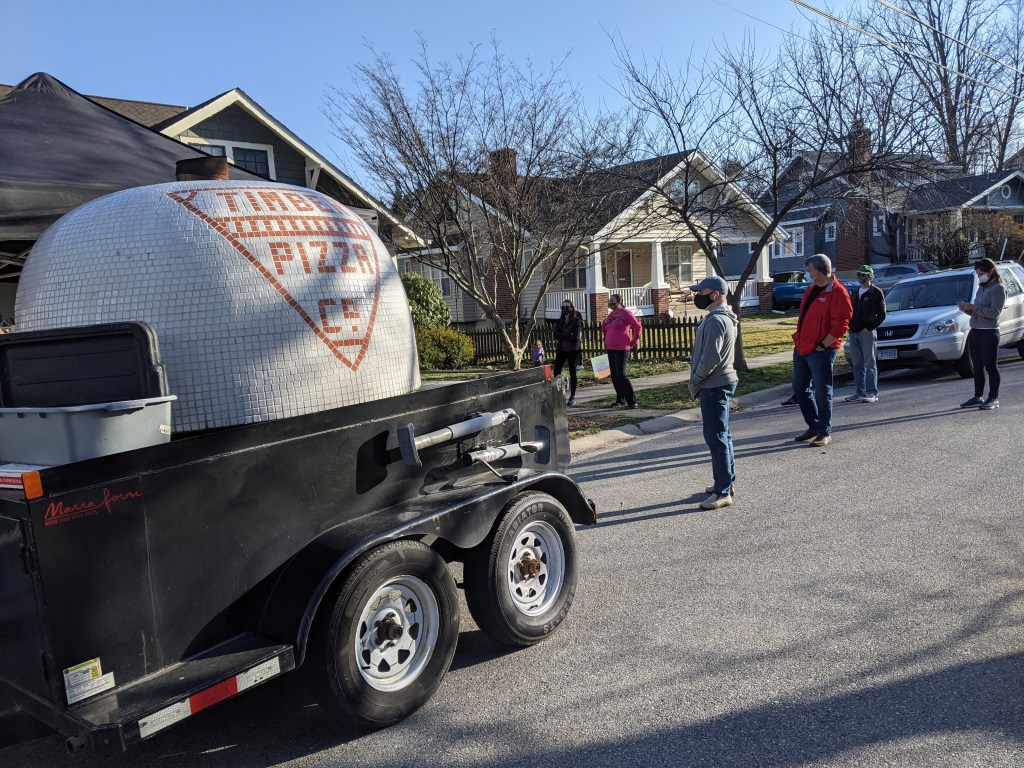
The local food scene has gotten a big boost, thanks to Debra Zatz who has begun organizing monthly food truck visits to the neighborhood. On March 20, Timber Pizza set up shop on Glen Ross, selling a whopping 210 pizzas in just a few hours. On April 16, Seoul Spice delivered 42 orders, and on May 4, Hangry Panda delivered 43 orders.

Next up:

May 18: Pakos
May 26: Money Muscle
May 31: Call Your Mother
June 1: Timber Pizza
June 11: Little Sesame
June 17: Little Serow
June 22: Puddin’
June 30: PhoWheels
July 5: Call Your Mother (9am-1pm)
July 6: Mina’s Tamales
July 10: Timber Pizza
July 13: Muchas Gracias
July 17: Money Muscle
July 21: Shouk
July 27: pop-up poutine and patisserie (5-7:30pm)
August 1: Queen’s English
August 5: Little Sesame
August 12: Bund Up
August 25: Timber Pizza
September 14: Silver and Sons 
September 23: Little Serow
September 24: Cipollo Rossa
September 30: pop up patisserie 
October 7: Silver and Sons
October 14: Little Sesame
October 20: Timber Pizza

Many of the upcoming food trucks will offer both pre-orders and walk ups between 4-8 pm. For more details, stay tuned to the listserv or join the North Woodside Eats (Facebook)