Georgia Ave Improvement Plan Achieves Key Milestone

By Geoff Gerhardt

On Thursday, September 4, state and local leaders gathered in Montgomery Hills to announce that the project to make long-awaited improvements to Georgia Avenue is now fully funded.

The Maryland Department of Transportation (MDOT) Draft Fiscal Year 2026–2031 Consolidated Transportation Program allocates funds needed to complete the $50.8 million Georgia Avenue project. Final design is complete, right-of-way acquisitions and utility relocations are underway, and construction will begin in spring 2028.

In announcing funding for the project, State Highway Administrator William Pines said, “[The State Highway Administration] is excited to see this important safety project advance, bringing improvements that will enhance safety, connectivity, and accessibility for all highway users. The partnership with the community has been critical to moving this project forward and we look forward to coming back to celebrate its completion.”

For more than 40 years, plans have circulated to transform Georgia Ave. in Montgomery Hills into a tree-lined boulevard that feels like a neighborhood street, not a highway cutting through the middle of the surrounding neighborhoods. For decades, those plans stalled. The heart of Montgomery Hills is too often treated as a place to drive through rather than a destination to walk, bike, gather, and shop.

When complete, the reimagined Georgia Avenue corridor will:

  • link to community assets—improved walking and biking access will make it easier for residents to connect with local businesses, Forest Glen Metro, downtown Silver Spring, nearby schools, and eventually the Purple Line.
  • be safer for everyone—replacement of the reversible lane with a median, improved sidewalks, and protected
  • cycle lane will make traveling along the corridor easier and safer whether you’re on foot, on a bike, in a wheel
  • chair, or in a car.
  • support local businesses—a more attractive, walkable environment invites people to stop, linger, and shop locally.
  • space for a community park—realigning southbound 16th St. will make room to develop a new neighborhood park.
  • create a sense of place—with trees, wider sidewalks, and space for people, Georgia Avenue will become the kind of main street that strengthens neighborhood identity.

This is a landmark moment for Montgomery Hills. After decades of waiting, the vision of a tree-lined boulevard that connects rather than divides is finally within reach. The progress we have seen on this project is due in large part to community input and activism, including strong support from residents of North Woodside and the North Woodside Citizens’ Association.

Neighborhood Featured in Washington Post Article

North Woodside and two of its residents, Geoff Gerhardt and Gus Bauman, were featured in a Washington Post article this week on the neighborhoods surrounding the busy Georgia Ave. corrider:

Montgomery Hills’ leafy neighborhoods contrast with busy Georgia Ave.
Where We Live | Five communities share the benefits and challenges of suburban life near an urban thoroughfare.

By Barbara Ruben, September 17, 2025

Access the article for a limited time here.

Speed Limit Lowered on Georgia Ave

By Michelle Desiderio Foster

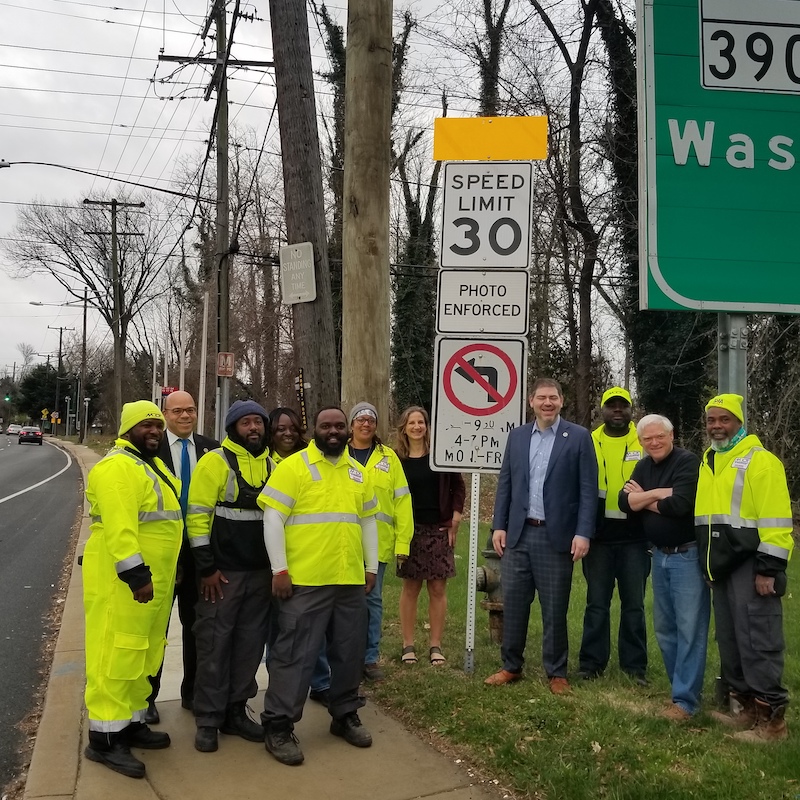
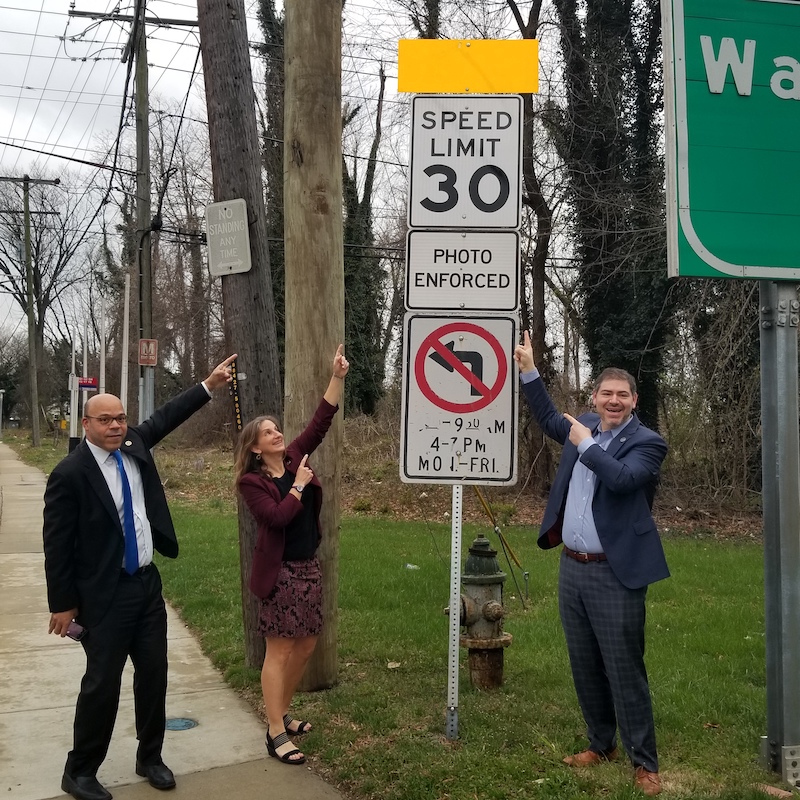
State delegates Al Carr, Lorig Charkoudian, and Jared Solomon point to the new speed limit sign on Georgia Ave. Photo by Michelle Desiderio Foster

The first of the long-awaited Georgia Ave. improvements in Montgomery Hills was implemented recently when the State Highway Administration (SHA) lowered the speed limit to 30 mph (from 35 mph) on Georgia Ave. from Spring St. to Wheaton. This speed limit was recommended in the Planning Department’s Montgomery Hills/Forest Glen Sector Plan adopted a few years ago. The speed reduction was just one of the significant improvements proposed for the corridor, including a green median, removal of the unsafe reversible lanes, wider sidewalks, a cycle track on the west side of the road, pedestrian-safety enhancements, a reconfigured Beltway interchange, and a new traffic light at Flora Lane.

A completed SHA design is expected by the end of 2022. Funding has been allocated for most of the necessary right-of-way acquisitions, and the county and state are cooperating to secure funds for utility relocation and construction. U.S. Senator Chris Van Hollen secured one million dollars in federal funding for the project in the recent infrastructure bill that Congress approved. Utility relocation could start as early as January 2024. State Delegates Jared Solomon and Lorig Charkoudian have worked tirelessly on this project to ensure that it continues to move forward and to secure necessary funding.

State delegates Al Carr, Lorig Charkoudian, Jared Solomon and State Highway Administration employees pose near the new speed limit sign on Georgia Ave. Photo by Michelle Desiderio Foster

This article first ran in the Spring 2022 issue of the Beacon.

Progress Continues Towards Improving the Georgia Avenue Corridor

By Geoff Gerhardt, Vice President

Following the Montgomery County Planning Board’s approval of the Forest Glen-Montgomery Hills Sector Plan in September, the County Council began the process of considering the plan. NWCA President David Cox and Vice President Geoff Gerhardt testified in support of the sector plan at a County Council hearing in November. Council committees are holding working sessions on the plan, and the full Council is scheduled to vote on it later this winter. Meanwhile, the State Highway Administration is making slow but steady progress on its plan for overhauling Georgia Avenue between 16th St. and Forest Glen Rd. Earlier this year, the state announced it had selected a version of the plan, known as Alternative 5B Modified.

This plan would bring wider sidewalks, protected bicycle track, and a landscaped median with dedicated left turn lanes to Georgia Ave. The plan would also make improvements to the Beltway interchange and eliminate the southbound “slip lane” at 16th St., creating a traditional “T” intersection instead.

The SHA plan is currently at the 30 percent design stage. This fall, the Federal Highway Administration gave preliminary approval to Alternative 5B Modified, which allows design and engineering efforts to move forward. Redesign plans for Georgia Ave. could be finalized by SHA by the end of this year.

However, much work remains to be done to secure construction funding for the project, which is estimated at $35–$40 million. In November, Geoff Gerhardt testified at a hearing of state senators and delegates representing Montgomery County in support of state funding for the project.

In addition, the Montgomery County Department of Transportation listed Georgia Ave. as its highest priority highway project in a draft letter to Maryland Department of Transportation. The final letter is scheduled to be sent to Maryland DOT this spring. Assuming it’s finalized, placement of Georgia Ave. at the top of the county’s transportation priorities list will be a huge victory—due in large part to letters and emails sent by residents of North Woodside. Thank you!