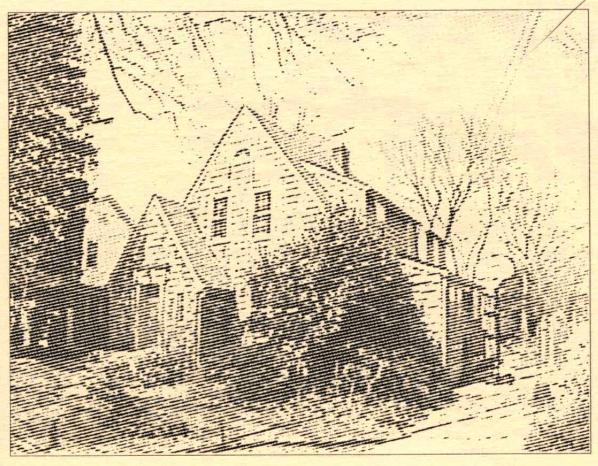
Graduate students in the University of Maryland’s Historic Preservation program have spent the last semester researching the history of eleven houses in Lyttonsville and North Woodside (and one in Woodside).
You are cordially invited to attend the capstone presentation of this historic house and local community research project, which will take place on Wednesday, December 15th at 7 pm, at Woodlin Elementary School. The students will give brief presentations on the histories of each of the twelve houses in the larger context of the history of these communities, with an emphasis on the most useful historic resources for conducting house histories. This event is sponsored by the Talbot Avenue Bridge Committee.*
Location information: Woodlin Elementary School (cafeteria/multi-purpose room) 2101 Luzerne Avenue, Silver Spring, MD 20910 Note: Use entrance at left side of building (next to school parking lot)
IMPORTANT SAFETY NOTE: Masks will be required, as well as proof of COVID-19 vaccination (or a negative COVID-19 test result taken within 72 hours of the event).
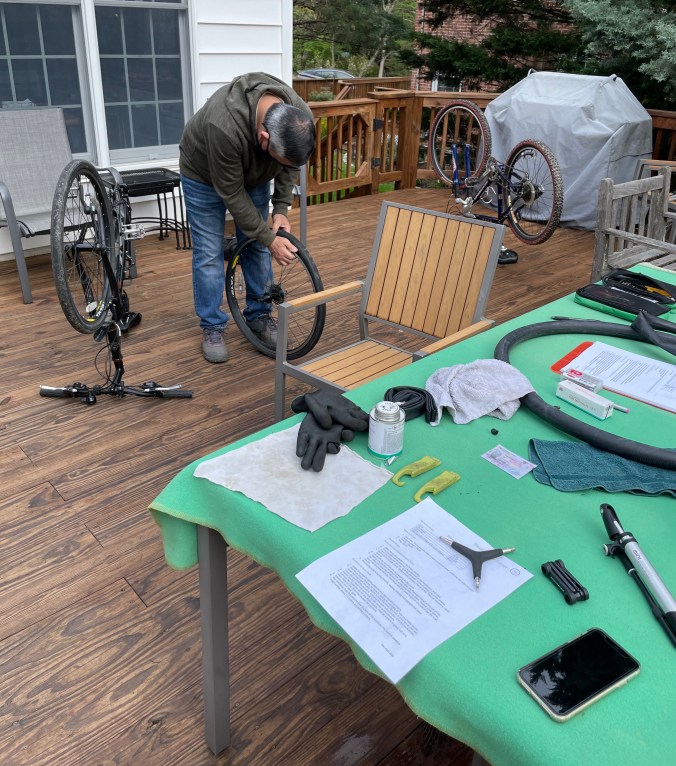
A flat tire is one of the most common mishaps that can occur while riding a bike. A piece of metal, glass, or even a thorn can end an otherwise enjoyable ride. I am offering a free hands-on workshop to show you how to repair a flat tire while on the road or trail. At the end of the two-hour session you will know how to remove a damaged wheel, identify the cause of the flat, locate the puncture, repair the inner tube, and what basic tools you should carry to take care of such an emergency. All materials, including patches, cement, practice tubes, and written step-by-step instructions will be provided.
Sessions will be limited to two participants, ages 16 and up, and will be held outdoors on my deck with plenty of spacing between us. Masks will be required. Bring your bikes to practice removing a wheel and mounting it when the repair is completed. We will practice patching a puncture on inner tubes that I provide. I plan to hold these sessions through the spring and summer. If interested, please contact me to schedule our workshop.
–Manuel Vera
Kudos to Manuel who has serviced a whopping 98 bikes for free since April 2020 and fixed up and given away 32 donated bikes!
For more information about Manuel’s bike tune up services and bike donation project:
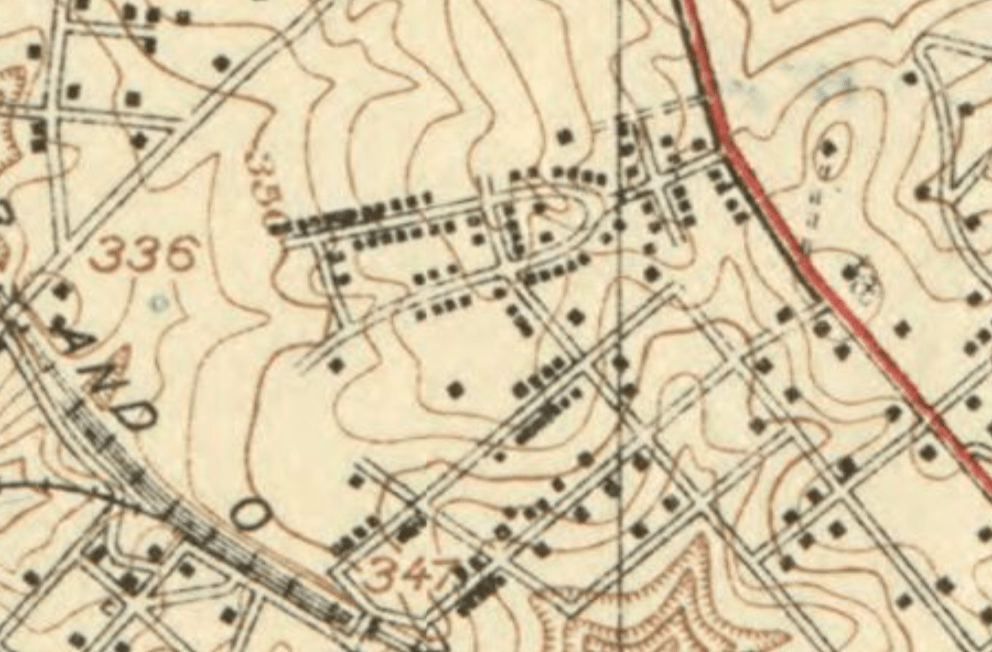
North Woodside in 1929. Source of Map: Library of Congress, Geography and Map Division.
Some links to a bunch of historical maps that show North Woodside in its younger days (zoom in just above the northern tip of DC to where it says “Woodside”)
1891 (year after our neighborhood was established)
1893 (shows the neighborhood lies ~7.5 miles from White House)
1917 (shows bridge that preceded the historic Talbot Avenue Bridge, built in 1918 and demolished in 2019) Note: if you live in one of the oldest houses in the neighborhood you should be able to find your house on this one.
1929 (#2) Note: many more neighbors should be able to find their houses on this one — particularly those living in bungalows and Sears Kit houses on Grace Church, Hanover, Glen Ross, Luzerne, and 2nd.
So interesting to imagine what this area looked like back then. Very little development and no Beltway yet!
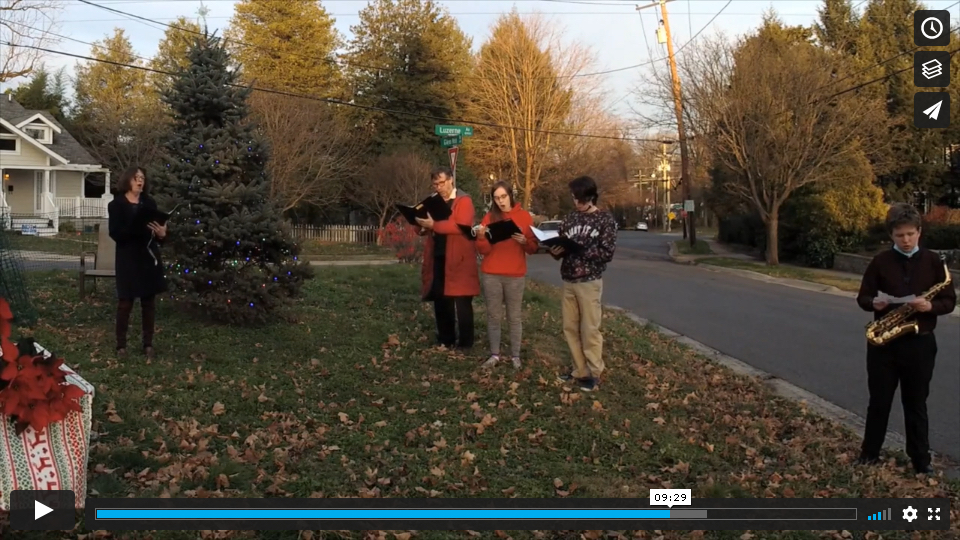
Singing following the lighting of North Woodside’s Community Tree on December 13, 2020
This year’s Tree Lighting program, organized by Holiday Committee Co-Chair Julie Lees, opened with an alto sax version of Let It Snow, followed by a small group of physically distanced singers blending their voices together for Dona Nobis Pacem (Give Us Peace).
After a few words of welcome by NWCA President David Cox, the Community Tree was lit and O Christmas Tree sung. Then it was time for a certain white-bearded man’s arrival to the tune of Santa Claus Is Coming to Town. Neighborhood children came, by appointment, to greet Santa and pick up treats. The event was streamed live and can be viewed below.
Thanks to Snider’s for once again donating a box of oranges for Santa’s treat table.
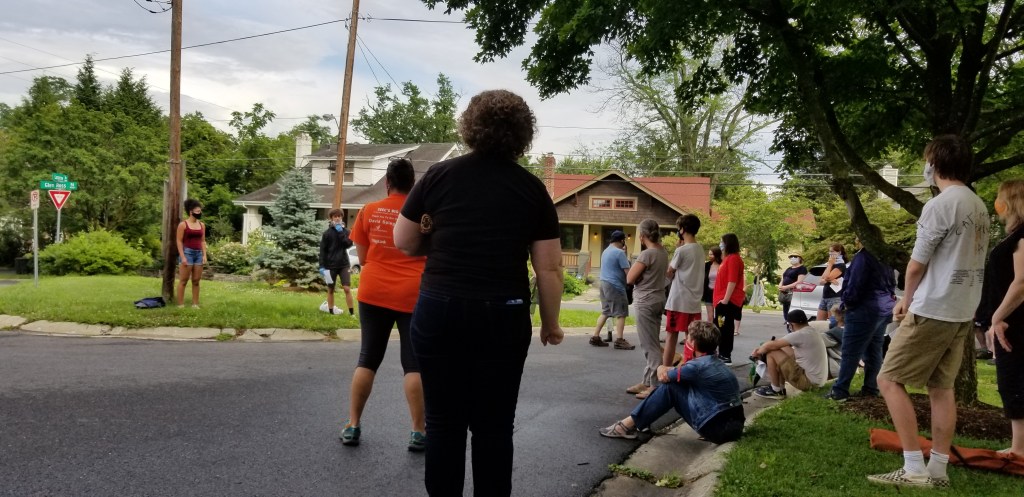
In June, Avery Smedley and Luca Utterwulghe (above at left), seniors at Albert Einstein High School, led a well-attended community conversation on racism.
By Isabel M. Estrada Portales
Let me run a couple of scenarios by you. Raise your mental hand if they seem familiar.
You consider racism abhorrent and often tell yourself and others that you don’t see race.
You want to acknowledge the contributions of Blacks, so every February you assign your students readings from Black authors, attend the Black History Month celebration at work, and talk to your children about it.
You like diversity in schools and neighborhoods because it prepares kids to deal with a world full of people of different races and ethnicities.
Keep these scenarios in mind and read on.
This summer, amid the anguish and rage that peaked with the murder of George Floyd at the knee of a police officer, our neighborhood’s kids did us proud. Luca Utterwulghe, 17, and Avery Smedley, 17, both of Luzerne Ave., called a meeting to discuss how our community can support the needed transformation for racial equality and justice in our country and county. Above their great advice, we heard a question anyone with kids has heard before: “Are we there yet?”
Avery Smedly, the President of AEHS’s Black Student Union and the founder/leader of Montgomery County Students Toward Equitable Public Schools (STEPS). Luca Utterwulghe, also part of STEPS, is a co-leader of AEHS’s Montgomery County Students for Change. Naomi Weintraub, a youth educator, also helped organize the event. This section incorporates information from a handout they distributed.
In the car ride of racial equity, their impatience with our slow driving is justified. To speed things up, they call on us to be antiracists by actively identifying and eliminating racism through changes in systems, organizational structures, policies, practices, and attitudes, so that power is redistributed and shared equitably.
Think about the scenarios above. If you don’t see race, can you see racism? Can you notice if your workplace’s hiring practices keep people of color out even unintentionally?
If you don’t see race, do you consider the potential dire consequences before calling the police on a Black person? Do you wonder what made you think the police were needed?
In your syllabus, are all the Black contributions crowded in February? Do you solicit Black expertise only about racial matters?
When you think about diversity, is it your kids or their kids you are thinking off? Is it hard to hear that kids of color are not “training wheels” for when white kids graduate to the “big bike” that is the world? What else would you do to achieve that diverse environment? Would you move to a mostly Black neighborhood? You say those schools are bad? Why? And why should income and zip code determine the quality of kids’ education?
We try to do right, but as our exasperated kids tell us, waiting for the arc of history to bend towards justice is taking too darn long. We need new approaches and changes at every level. Some of it begins by talking about things that hurt. (Trust that none of us, including people of color, find these conversations easy.)
Even our language needs to change—why capitalizing Black is meaningful—to confront and unlearn racist mindsets to act in accordance with our values.
Hear out Black people when they bring up issues and actions that you might not have thought were racist. People of color don’t often expect racial slurs in this neighborhood, but inadvertent slights are all too common.
Let friends and family know that neighborhood schools give us an immediate opportunity for committed antiracist action. We can support equity-focused and antiracist policies at the county level and at the Board of Education. Begin with advocating for the pending district-wide boundary analysis.
You can email MCPS Board members to call for police-free schools. The presence of police is experienced quite differently by Black and brown children. Use the hashtag #CounselorsNotCops.
Let’s start having difficult conversations in small groups or one-on-one. Are you concerned about any of this? Have you had a negative experience with a neighbor or passerby? We can talk it out as neighbors and fellow citizens. If we can’t talk to the people who live nearby, our chances as a country are slim.
There is a lot more, but how about we just talk? Contact Isabel.
Woody Brosnan, a North Woodside resident for more than 30 years, died at home on April 15, 2020. Self-described as a “civic busybody” and called the Mayor of North Woodside by others, Woody was an active community volunteer and organizer, who served on the board of the North Woodside Citizens Association.
The news of his death spurred an outpouring of tributes, with neighbors describing him as a great neighbor; a kind and principled human being; a leader in our community; a decent, kind soul; a mainstay of the neighborhood; an anchor of the community and so many good causes; a tireless activist; and his death as a huge loss for our neighborhood and the larger community.
Woody and family moved here at a period when I was president of our citizens association and then chairman of the Maryland-National Capital Park and Planning Commission (MNCPPC). It was during what the press called the Silver Spring War, between 1984 and 1996. As Woody became engaged with the issues (Purple Line was a part of the overarching struggles), we would talk. In time, he came to work for an At-Large County Councilmember who lived in the Bethesda area. In those years, he importantly brought to her office a perspective about Silver Spring’s unique character and attributes that she otherwise would not have had. She grasped the significance of a new Blair High School and Purple Line and revitalized downtown Silver Spring. As chairman of MNCPPC and thereafter, Woody would remind me of the value of our modest Sligo Golf Course, “Even though you’re no golfer, Gus.” I always valued Woody’s quiet voice.
—Gus Bauman
Resolution Honoring James “Woody” Brosnan
December 15, 2019
The North Woodside Citizens Association hereby resolves to honor the contributions of James “Woody” Brosnan to the neighborhood of North Woodside and the greater Silver Spring community.
As a longtime resident of North Woodside, and former president of the Citizens Association, Woody spent many years working to improve the quality of life of those who live here. His capacity to see all sides of an issue and pragmatic approach to problem solving have helped to shape the neighborhood’s approach to many issues.
His dedication to bettering the lives around him goes beyond his immediate neighborhood. In addition to serving on the Association’s executive board, Woody has also been a longtime member of the Presidents’ Council of Silver Spring Civic Associations (Prezco), co-founder of Safe Silver Spring, president of the Sligo Creek Golf Association, and staffer for former Councilmember Duchy Trachtenberg. His leadership across a range of organizations has served to inspire others to get involved in efforts to improve the community.
Besides his community service, Woody is also well known as a loving husband and father and for his distinguished career as a journalist.
Those who live in North Woodside are lucky to have Woody Brosnan as a neighbor, friend and community leader. We take great honor in recognizing Woody’s contributions to our neighborhood and thanking him for his service and friendship.
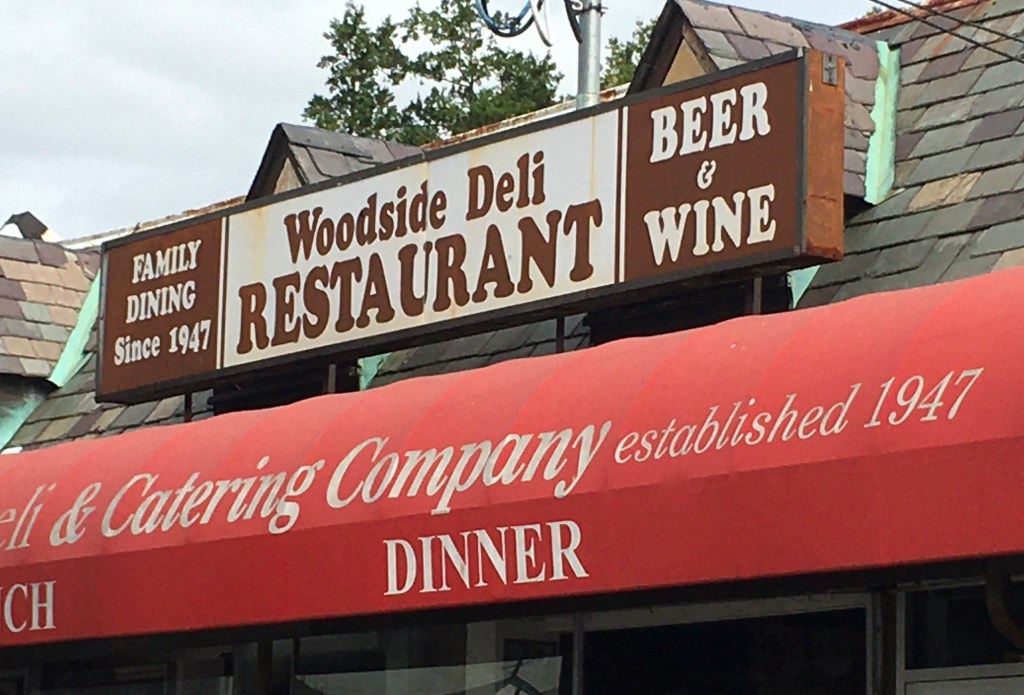
The original Woodside Deli on Georgia Ave—a much-loved neighborhood institution for 72 years—closed suddenly in early October due to a disagreement with the landlord on renewing the lease. Many neighbors expressed shock and sadness over the closing on the neighborhood email list. A Woodside Deli memory from a long-time neighborhood resident:
When I lost to Doug Duncan in the 1994 Democratic primary for County Executive, he was nervous about who I might support in the November general election. The Republican nominee was a smart, popular elected official (in those times, the County GOP was a real player—we had Republican Councilmembers and our Congresswoman was Republican) and Doug ran poorly in this area of the County.
So after the primary election we met at the Woodside Deli to discuss specific issues we differed on, the coming campaign, and my potential endorsement. The Woodside was a popular spot for politicians and reporters alike and remained so to its very unfortunate demise. Just yesterday (October 10), I got an e-mail from a prominent reporter saying, “ Oh no, now where can we meet and talk over breakfast?”
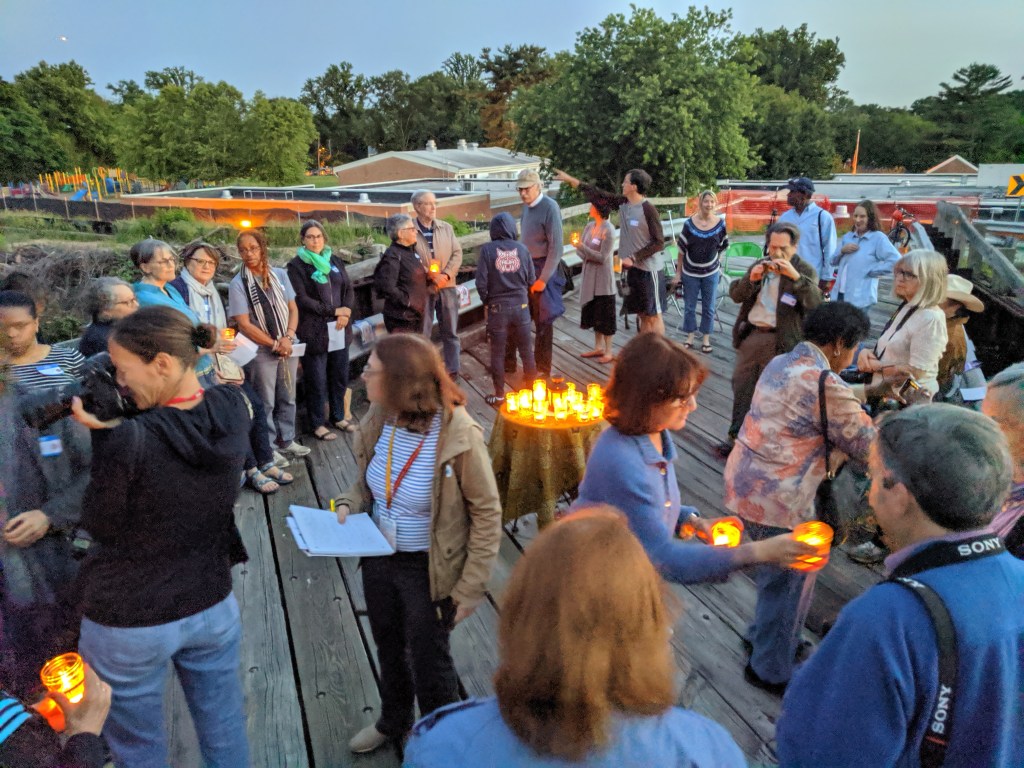
Talbot Avenue Bridge Candlelight Vigil, on eve of the century-old bridge’s final closure before demolition.
On June 4, 2019, the Purple Line Transit Constructors closed and began demolition of the historic wood and steel Talbot Avenue Bridge. Built in 1918 from an overturned train turntable from West Virginia, the century-old Bridge was the last remaining historically-significant structure of the historically African-American community of Lyttonsville, founded in 1853 by free man of color Samuel Lytton. Originally two-lane, the Bridge served as a lifeline to Lyttonsville residents through a significant portion of the 20th Century, when Silver Spring was very starkly racially segregated and ~50 neighborhoods in Silver Spring, including North Woodside, had racially restrictive deed covenants that prohibited African Americans from owning property or living in them, except as domestic servants. In recent years, current and former Lyttonsville residents have shared visceral memories of racial bigotry they experienced in North Woodside, and how they viewed efforts by North Woodside residents to permanently close the Bridge in the 1990s as racially-motivated.
A year ago, Lyttonsville, North Woodside, and Rosemary Hills neighbors came together to organize the Talbot Avenue Bridge Centennial Celebration at which NWCA President David Cox presented a unanimously-passed NWCA Board resolution acknowledging and strongly denouncing racial bigotry in all its forms, past and present. North Woodside is the first (and only so far) neighborhood in Montgomery County—and one of only a few in the U.S.—to publicly acknowledge and denounce racist deed covenants of the past. Read the resolution in full and view its presentation.
Over the past year, neighbors connected by the Bridge have continued to collaborate, organizing a number of Bridge-related social and educational community events. At sunset on the eve of the Bridge’s closing community members gathered on the Bridge one last time for a Candlelight Vigil to mark this transition and enjoy a final moment in the historic space.
On July 5, 2019, a small crowd gathered for the much anticipated lifting of the Bridge’s steel girders. The girders are currently being stored by the County, along with other saved parts, for eventual placement along the Capitol Crescent Trail in a new County park that will be created in Lyttonsville following Purple Line construction.
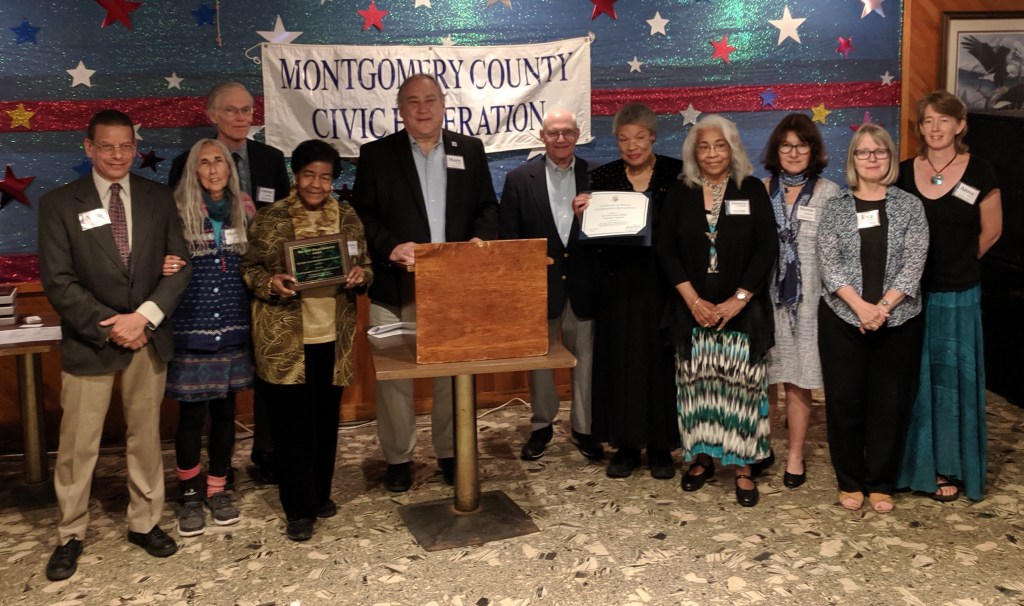
On June 13, 2019, County Executive Marc Elrich presented Montgomery County Civic Federation’s Wayne Goldstein Award to the Talbot Avenue Bridge Centennial Committee for their work for racial reconciliation and preservation of elements of this historic bridge to educate future generations about segregation in Montgomery County’s history: Alan Bowser, Marcie Stickle, George French, Charlotte Coffield*, Joel Teitelbaum†, Pat Tyson*, Elmoria Stewart*, Merrie Blocker‡, Eva Santorin†, Anna White‡. Not pictured: David Rotenstein, Laura Hussey. *Lifelong resident of Lyttonsville; †Rosemary Hills resident; ‡North Woodside resident
County Executive Marc Elrich and Council Member Evan Glass presented longtime neighborhood leader Woody Brosnan with a proclamation on August 20, 2019 to recognize his dedication of countless hours for the betterment of Montgomery County and its residents, including through his service as NWCA President, member of the Presidents Council of Silver Spring Civic Associations (Prezco), and as a founding member of Safe Silver Spring. In these roles, he has been “an advocate for common sense solutions in the community and [played] an important role in bridging differences among his neighbors.”
North Woodside’s neighborhood school, Woodlin Elementary, welcomed Craig O. Jackson as its new principal this fall.
Mr. Jackson has worked in education for over 20 years. Most recently, he was principal intern at Cannon Road Elementary School in Silver Spring. He also served as assistant principal at Dr. Sally K. Ride Elementary School, assistant school administrator at Sligo Middle School, technology teacher at John F. Kennedy High School and as a health and physical education teacher in the DC Public Schools system.
Though he has worked in both middle and high schools, Mr. Jackson says he was drawn to elementary school administration because, “You can have that first crack at getting kids to love school.” He is focused on meeting each child where he or she is, he says, and doing what is needed to move that child forward. Since so many of Woodlin’ s children are beyond school ready when they enter kindergarten, Mr. Jackson will offer more enrichment and acceleration opportunities for kids who need more challenges.
The members of the Woodlin interview panel selected Mr. Jackson as principal, in part, because they were impressed with his track record of building relationships and collaborating with key stakeholders, including students, parents, teachers and community members. For example, during his tenure at Cannon Road, Mr. Jackson created a community partnership with senior citizens in the neighborhood, who became regular volunteers in the school’s classrooms.
Mr. Jackson is getting to know Woodlin’s Parent Teacher Association and says he is impressed. He is working closely with PTA leadership to determine where the administration and parent leaders can best focus their advocacy and school improvement efforts. Above all, he says it is important to him that the administration and the PTA stay in close communication and send unified messages.
Mr. Jackson and his wife have children ages 16, 14 and 2. They live just over the border in Washington, D.C. He grew up as a student in Montgomery County schools.




 Welcome to North Woodside