By Isabel M. Estrada Portales
Let me run a couple of scenarios by you. Raise your mental hand if they seem familiar.
You consider racism abhorrent and often tell yourself and others that you don’t see race.
You want to acknowledge the contributions of Blacks, so every February you assign your students readings from Black authors, attend the Black History Month celebration at work, and talk to your children about it.
You like diversity in schools and neighborhoods because it prepares kids to deal with a world full of people of different races and ethnicities.
Keep these scenarios in mind and read on.
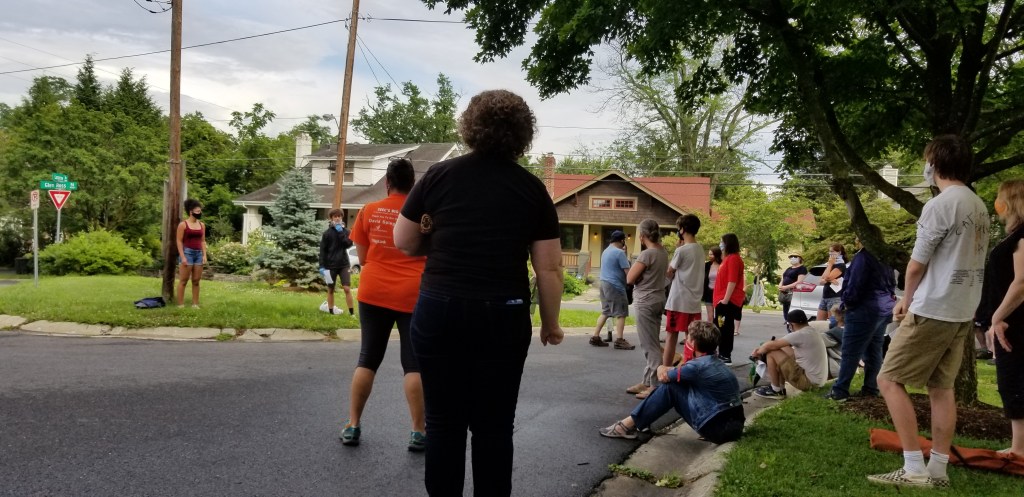
This summer, amid the anguish and rage that peaked with the murder of George Floyd at the knee of a police officer, our neighborhood’s kids did us proud. Luca Utterwulghe, 17, and Avery Smedley, 17, both of Luzerne Ave., called a meeting to discuss how our community can support the needed transformation for racial equality and justice in our country and county. Above their great advice, we heard a question anyone with kids has heard before: “Are we there yet?”

In the car ride of racial equity, their impatience with our slow driving is justified. To speed things up, they call on us to be antiracists by actively identifying and eliminating racism through changes in systems, organizational structures, policies, practices, and attitudes, so that power is redistributed and shared equitably.
Think about the scenarios above. If you don’t see race, can you see racism? Can you notice if your workplace’s hiring practices keep people of color out even unintentionally?
If you don’t see race, do you consider the potential dire consequences before calling the police on a Black person? Do you wonder what made you think the police were needed?
In your syllabus, are all the Black contributions crowded in February? Do you solicit Black expertise only about racial matters?
When you think about diversity, is it your kids or their kids you are thinking off? Is it hard to hear that kids of color are not “training wheels” for when white kids graduate to the “big bike” that is the world? What else would you do to achieve that diverse environment? Would you move to a mostly Black neighborhood? You say those schools are bad? Why? And why should income and zip code determine the quality of kids’ education?
We try to do right, but as our exasperated kids tell us, waiting for the arc of history to bend towards justice is taking too darn long. We need new approaches and changes at every level. Some of it begins by talking about things that hurt. (Trust that none of us, including people of color, find these conversations easy.)
Even our language needs to change—why capitalizing Black is meaningful—to confront and unlearn racist mindsets to act in accordance with our values.
Hear out Black people when they bring up issues and actions that you might not have thought were racist. People of color don’t often expect racial slurs in this neighborhood, but inadvertent slights are all too common.
Let friends and family know that neighborhood schools give us an immediate opportunity for committed antiracist action. We can support equity-focused and antiracist policies at the county level and at the Board of Education. Begin with advocating for the pending district-wide boundary analysis.
You can email MCPS Board members to call for police-free schools. The presence of police is experienced quite differently by Black and brown children. Use the hashtag #CounselorsNotCops.
Let’s start having difficult conversations in small groups or one-on-one. Are you concerned about any of this? Have you had a negative experience with a neighbor or passerby? We can talk it out as neighbors and fellow citizens. If we can’t talk to the people who live nearby, our chances as a country are slim.
There is a lot more, but how about we just talk? Contact Isabel.
 Welcome to North Woodside