Covid-19 Memoriam and Reflection

White flags honor lives lost to Covid-19, part of a installation outside RFK Stadium in October 2020. Photo by Holly Furdyna

On April 10, 2023, President Biden signed a resolution formally ending the coronavirus national emergency enacted in March 2020, and the White House plans to end a separate coronavirus public health emergency and disband its Covid-19 Response Team on May 11, 2023. More than three years since the global pandemic reached our area, it seems we are finally transitioning out of the “time of Covid,” a period that has affected all of us in one way or another.

To mark this transition, we would like to acknowledge the hard work of all neighbors who rose to meet the challenges of the pandemic, whether serving as an essential worker or scrambling to find adequate PPE for them, frantically switching to teaching students online, juggling work and young children at home, caring for ill family members, providing resources to those in need in our community, and much more.

It was a difficult time for many neighbors, especially those whose lives were touched by the loss of loved ones, whether from Covid-19 or by other causes, with opportunities to say goodbye and rituals for grieving severely limited by restrictions on in-person gatherings. In the Spring 2023 issue of the Beacon we recognized the human loss of the pandemic, through the lens of people who live or work in North Woodside. This list of names is, no doubt, incomplete. Condolences to all neighbors and their families who were touched by the deaths of loved ones these past three years.

Amidst the challenges and heartaches, there were also positive aspects of the pandemic for many: the slowing down of the busyness of life, spending quality time with immediate family members, connecting with neighbors in creative ways, finding time to take up new hobbies, and much more.
How were you impacted by the pandemic? And how has your life changed as a result of it? What memories will you carry with you for the rest of your life? We all have a story we could share. In the Spring 2023 issue of the Beacon, we spotlighted one neighbor’s personal story of loss, as well as its silver lining.

Covid Remembrance

By Eric Schechtman

Eric Shechtman holds a photo of his parents on their wedding day.

We are now three years since the pandemic began impacting us in March 2020. Many people lost loved ones. Early in the pandemic I lost both of my parents, Allan and Judy Schechtman, within nine weeks of
each other.

My parents lived in Cleveland, Ohio, their entire lives. I grew up there, and after a short stint in Los Angeles, work brought me to this area and North Woodside in the late 1980s. I have no family here, so my wife, Shira, and I would go see my parents in Cleveland at least three times a year for Passover, the Jewish New Year, and Thanksgiving. Even after they moved out of my childhood home and into a senior apartment, we kept this pattern. So when we said goodbye at Thanksgiving in 2019, we never imagined that was the last time we would visit either of them in their apartment.

In April 2020, just one month after much of the world shut down and with my parents’ building locked down, we were forced to celebrate Passover via Zoom. Only aides, screened daily for fever, were allowed in. We think an aide brought Covid to them. Just one month later, my father was diagnosed and admitted to the hospital the same day. Two days later we dropped everything and traveled to Cleveland. Unfortunately only one of us—my brother—was allowed into his room, so I had no opportunity to say goodbye. Three hours later my father was gone.

The death-and-mourning traditions we have in Judaism are very helpful for coping with the loss of a loved one. But two of them—a funeral service and the tradition of shiva—were taken away. We had to hold a graveyard service, with very limited attendance, and I (rather than a rabbi) sang the memorial prayer. Shiva, the first seven days of mourning, is normally a time when family and friends come to visit, but we had to do it over Zoom. It was very lonely.

Nine weeks later we had to repeat this for my mother, but at least this time we had five days to say goodbye.

The Silver Lining

The traditions Judaism provides for death and mourning make sure no one is totally alone. After losing a loved one, we join a minyan (a group of at least 10 adults) to say the memorial prayer morning and night daily. For parents we do this for 11 months.

Others in the minyan may also be mourning. This becomes a support group by another name. At each anniversary of a loss, a minyan member speaks to the group about their loved one, even many years later; it helps to bring them alive.

Not every congregation is large enough to support this, including my local one. But I could Zoom anywhere around the world, so I found solace at my childhood congregation in Pepper Pike, Ohio. By joining there, I also had a way to break into a minyan group where I didn’t know anyone: Those my father taught when they were children recognized my name. I became more integrated into the morning and evening minyans over four months, and I ended up rejoining this congregation.

At almost exactly the end of 11 months of prayer for my mother, in-person attendance was allowed again, even as Zoom continued, so my wife and I took the opportunity to travel there periodically. I began reconnecting with members of my childhood congregation, who got me through all of this. To stay connected I became the Zoom host for all their services, and now three years later we have completely integrated into our new congregation as very active members, even though we live here. This is the silver lining—a gift from a very difficult situation.

Delivering the Mail Through Rain, Shine, Snow, and Covid

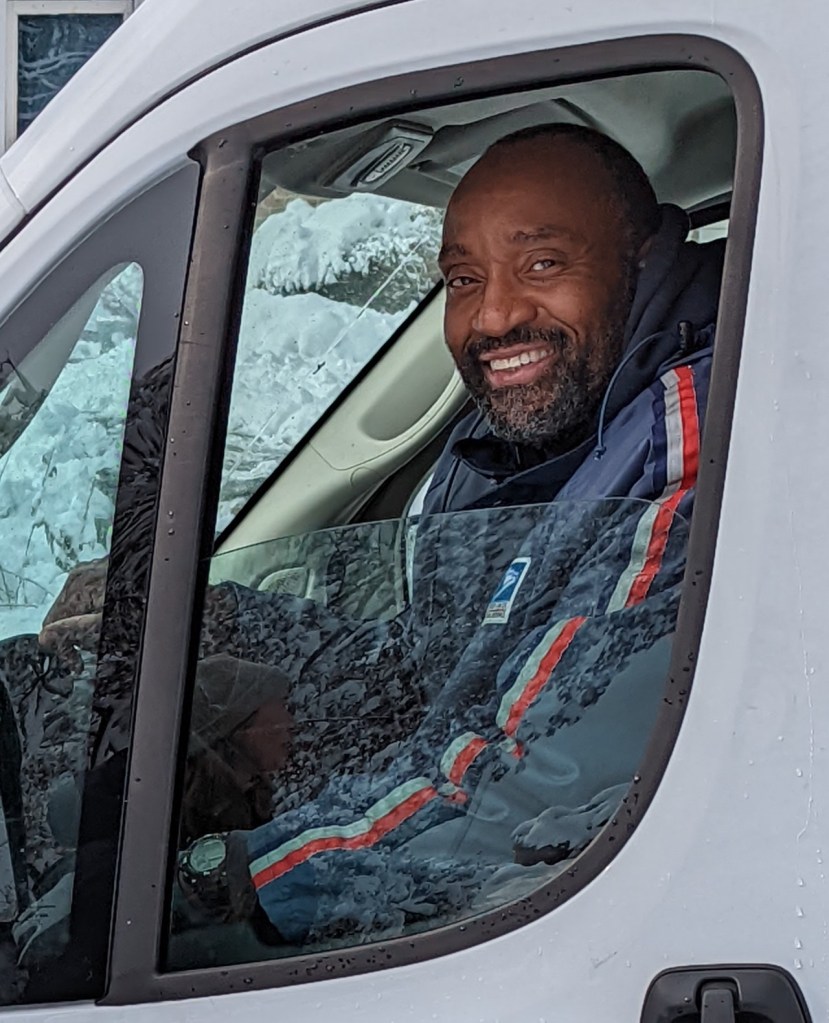
Anthony delivering mail in the neighborhood on a snowy January day. Photo by Lilian Pintea

An Interview with Anthony St. Hill, USPS Postal Carrier
by Anna White

If you live in the neighborhood, particularly on Glen Ross Rd. or south, there’s a good chance you’ve crossed paths with Anthony St. Hill, a USPS postal carrier who has delivered mail to the neighborhood for almost 15 years—as a one-day-a-week replacement carrier for over six years and then full-time for the past eight. He is one of two postal carriers who serve North Woodside full-time; the other is Marqueze Bradley, who has delivered in the northern section of North Woodside for three years. Known for his conscientious service, Anthony knows by heart the names and addresses of all the neighbors—human and canine—along his route. In January, he graciously agreed to a phone interview on his one day off.

What is a typical workday and workweek for you?

On a regular day, we deliver packages and mail simultaneously. Only during Christmas season do we deliver earlier. Then we come in at 5:00 am and deliver packages until 8:00 am. My normal route starts at 7:45 am and goes to 4:25 pm—that’s my regular eight-hour day—but every day we have an additional two to three hours. I work six days a week. For regular carriers, the only day off is Sunday.

Do you get overtime pay?

Yes, we do get overtime because we are unionized. We get overtime after eight hours and then after 10 hours, we go into penalty time, which is double. We work anywhere from 10 to 12 hours on a daily basis. And with this COVID and stuff it’s even worse. Sometimes we have 10 to 12 carriers out sick, and then we have to cover those routes because the mail and the packages have to go there every day.

COVID has impacted your work?

At my station now we have about 10 carriers out. [Last year] it was the same way, and I was out. At the beginning I thought it was pneumonia, but when I got tested I was positive. Some of the people who worked next to me tested positive and management never told me, so then I was out almost the entire month of January 2021. With COVID it makes [the job] more strenuous, working longer hours on a daily basis, due to packages increasing with everyone ordering online and covering coworkers who are out sick.

What do you like about working in the neighborhood?

I love working in the neighborhood. For me, it’s like a family environment because I know each and every tenant on my route and they know me. I start at 2nd Ave. where the nursing home is and cover 2nd Ave., Hanover, Glen Ross, Lanier, Grace Church, Elkhart, 16th, the townhouses on Lyttonsville, the high-rises—all that is my environment. The families know me, the kids they know me, even the pets know me. I love my route because I love my tenants. They look out for me, and I look out for them. Most of my customers have access to my phone number. When they don’t see me for two or three days they call me to make sure I’m okay, on vacation. Is there any way neighbors could make doing your job easier? If you have a dog [that stays outside] put your mailbox at the curb to avoid any dog biting, because dogs are by nature territorial. That’s the only thing I would say. If the dog is inside, no problem. Most biting happens during summertime and other times when children are on break; children like to run outside to play and [forget] to close the storm door. If you are expecting mail, make sure your dog is inside.

Any interesting stories related to delivering mail in the neighborhood?

There are dogs I have to say hi to. When the owners are walking them and they pick up my scent I have to say hello to them or just pet them or they will not continue. And those are big dogs—Chula, she’s a pit bull. She lives in the high-rise. Anytime the owner walks her, she says, “Chula becomes a puppy when she sees you!” I have to pet her or she will not let the owner carry her anywhere else. Then I have Luna, on Lanier. She’s a husky with blue eyes. Same way. I have to say hi to her or she will not move. And I have Charlie. I have to say hello to him every time [or he] will keep barking and barking. People ask me, “You not afraid of dogs?” No, I grew up knowing dogs. I know about dogs. [The dogs on my route] are like extended family. Have to say hi to them or they will not continue their walk.

Is there anything about yourself you’d like to share with neighbors?

I was born in Panama, and I dance my national music. That is what exposed me to the world. My first travel outside of my country was [through dancing]. I used to perform on a ship in the Panama Canal from 1984 all the way to 1999, when I came to the United States. And I still perform my national music. I was one of the top dancers when I used to perform in my country. And I still perform here. I like it. I love it. I retired from dancing for six to seven years, but I started dancing again.

Anything else?

Like you to know I’m married, I have five kids, four grandbabies. That’s basically it. I’m a very religious person. I’m a faith Christian. God is the center my life. I’m Episcopalian. I usually go to church every Sunday. Only Sunday don’t go to church when I have to work. Other than that in church every Sunday. And that’s it. That’s who I am.

UPDATE: September 9, 2022 is Anthony’s final day delivering mail in the neighborhood. If you would like to express your appreciation to Anthony for his many years of excellent service, contact the NWCA Communications Coordinator for more information.

Inauguration Eve Luminary Display

Luminaries line 2nd Avenue on January 19, 2021

In response to the U.S. Capitol attacks and the Inauguration Committee’s Nationwide COVID-19 Memorial, Scott Vicary organized a neighborhood display of luminaries (brown paper bags with LED tea light candles inside). He envisioned them as a symbol of community solidarity in honoring lives lost, a lighted path to a better era, and a step toward healing.

Well over 50 households participated, including all those along Glenridge Rd. and Rookwood Rd. As neighbors lit their luminaries, 400 lights were lit along the Lincoln Memorial Reflecting Pool to represent the 400,000 lives lost in the U.S., a grim number reached that day.

Support the Education of Low-Income and Marginalized Kids in MCPS

The COVID-19 pandemic is disproportionately hurting low-income and Black and brown families, whose adults are overrepresented among essential workers. Their children, especially the younger ones, are falling further behind academically.The new Educational Equity and Enrichment Hubs provide a safe opportunity for in-person support for MCPS K-5 students, based on financial need. Learn more here: www.equityhubs.org.

To make a donation, visit here: www.thecommunityfoundation.org/cof-contribution. Any amount helps; in the Comments box add “For the Equity Hubs.”

* One student = $20
* Cohort of 13 students = $250
* Hub of 52 students = $1,000

— Isabel M. Estrada Portales