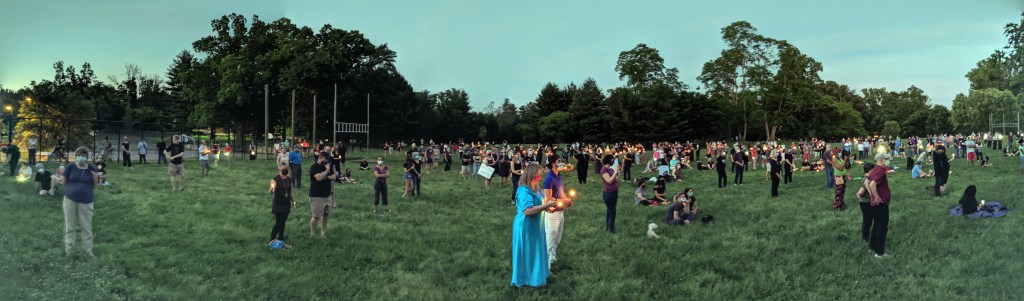
Hundreds of residents of Rosemary Hills, Lyttonsville, and North Woodside gathered in June for a candlelight vigil in memory of George Floyd, a Black man murdered by Minneapolis police. Participants were silent for 8 minutes 46 seconds, the length of time an officer kneeled on Floyd’s neck. His last words: I can’t breathe.
Before Calling the Police, Ask Yourself:
1. Is this merely an inconvenience to me? → Can I put up with this and be okay?
2. No, I need to respond. → Can I handle this on my own? Is this something I could try to talk out with the person?
3. No, I need backup. → Is there a friend, neighbor, or someone whom I could call to help me?
4. No, I need a professional. → Can we use mediation to talk through what’s happening, or is there an emergency response hotline I could call?
5. No. → If I call the police, do I understand how involving the police could impact me and the other person? If police are present do I know what to do? See below for some alternatives
Alternatives to Calling Police
And Ways to Help in Montgomery County
Mediation: Conflict Resolution Center of Montgomery County 301-652-0717, Mon.–Fri. 9:30 am–4:30 pm, or submit an online request. Mediation is a free, confidential, nonjudgmental, and voluntary process to develop solutions to conflict.
Mental Health: Montgomery County 24 Hour Crisis Center 240-777-4000 Provides services 24 hours/day year-round. Mobile Crisis Outreach will respond anywhere within Montgomery County to provide emergency psychiatric evaluations. Full crisis assessments and treatment referrals are provided for psychiatric and situational crises.
Victim Support and Sexual Assault: Montgomery County Victim and Sexual Assault Program (VASAP) 240-777-4357, 24-hours/day Information and referral, advocacy, crisis and ongoing counseling, support and compensation services for victims of crimes committed in Montgomery County or crime victims who live in Montgomery County, as well as to the victims’ families and significant others.
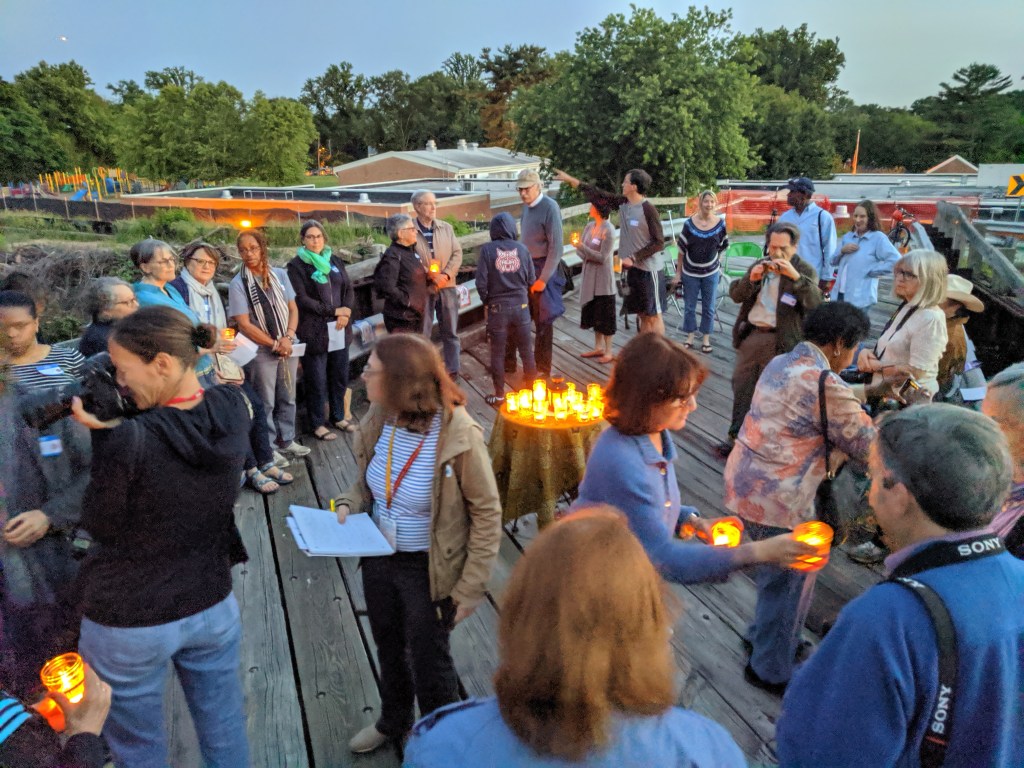
Talbot Avenue Bridge Candlelight Vigil, on eve of the century-old bridge’s final closure before demolition.
On June 4, 2019, the Purple Line Transit Constructors closed and began demolition of the historic wood and steel Talbot Avenue Bridge. Built in 1918 from an overturned train turntable from West Virginia, the century-old Bridge was the last remaining historically-significant structure of the historically African-American community of Lyttonsville, founded in 1853 by free man of color Samuel Lytton. Originally two-lane, the Bridge served as a lifeline to Lyttonsville residents through a significant portion of the 20th Century, when Silver Spring was very starkly racially segregated and ~50 neighborhoods in Silver Spring, including North Woodside, had racially restrictive deed covenants that prohibited African Americans from owning property or living in them, except as domestic servants. In recent years, current and former Lyttonsville residents have shared visceral memories of racial bigotry they experienced in North Woodside, and how they viewed efforts by North Woodside residents to permanently close the Bridge in the 1990s as racially-motivated.
A year ago, Lyttonsville, North Woodside, and Rosemary Hills neighbors came together to organize the Talbot Avenue Bridge Centennial Celebration at which NWCA President David Cox presented a unanimously-passed NWCA Board resolution acknowledging and strongly denouncing racial bigotry in all its forms, past and present. North Woodside is the first (and only so far) neighborhood in Montgomery County—and one of only a few in the U.S.—to publicly acknowledge and denounce racist deed covenants of the past. Read the resolution in full and view its presentation.
Over the past year, neighbors connected by the Bridge have continued to collaborate, organizing a number of Bridge-related social and educational community events. At sunset on the eve of the Bridge’s closing community members gathered on the Bridge one last time for a Candlelight Vigil to mark this transition and enjoy a final moment in the historic space.
On July 5, 2019, a small crowd gathered for the much anticipated lifting of the Bridge’s steel girders. The girders are currently being stored by the County, along with other saved parts, for eventual placement along the Capitol Crescent Trail in a new County park that will be created in Lyttonsville following Purple Line construction.
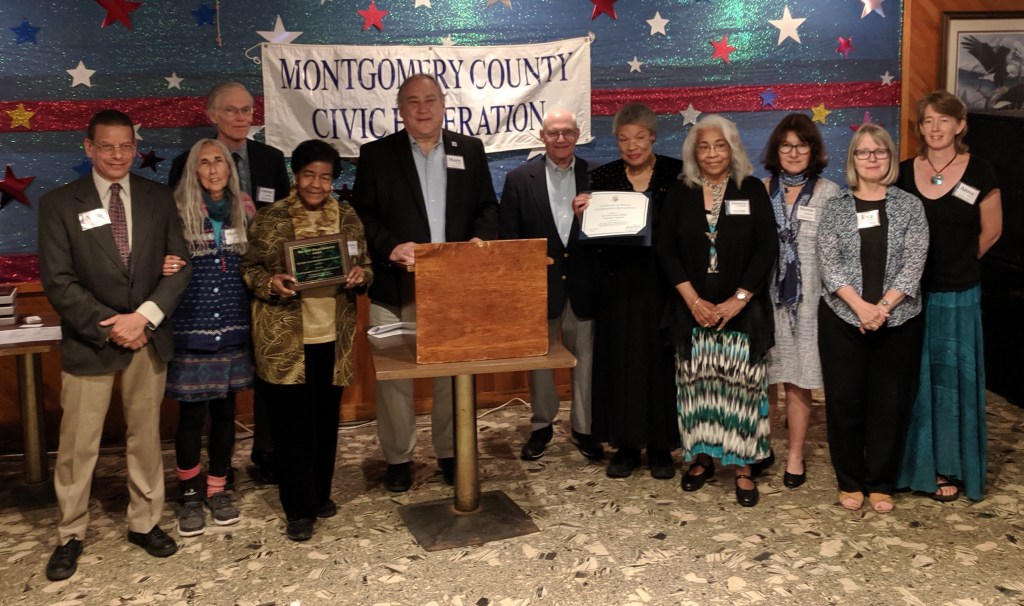
On June 13, 2019, County Executive Marc Elrich presented Montgomery County Civic Federation’s Wayne Goldstein Award to the Talbot Avenue Bridge Centennial Committee for their work for racial reconciliation and preservation of elements of this historic bridge to educate future generations about segregation in Montgomery County’s history: Alan Bowser, Marcie Stickle, George French, Charlotte Coffield*, Joel Teitelbaum†, Pat Tyson*, Elmoria Stewart*, Merrie Blocker‡, Eva Santorin†, Anna White‡. Not pictured: David Rotenstein, Laura Hussey. *Lifelong resident of Lyttonsville; †Rosemary Hills resident; ‡North Woodside resident


 Welcome to North Woodside